Fresh Milk vs Processed Milk: A Founder's Plain-English Guide
Ask ten people what separates fresh milk from processed milk and you will get ten answers, most of them half right. I am Aryan Sharma, and I started PYAAS because I was tired of that fog around something as everyday as a glass of milk. So here is the plain-English version, no chemistry degree required: what processing actually does, and what freshness really changes in your glass.
So what does "processed" even mean?
Almost every carton you buy has been through some processing, and most of it is there for a good reason. Three words are worth knowing. Pasteurising means the milk is heated briefly to kill harmful bacteria, which is a genuine safety step. Homogenising means the fat is broken up and blended in so the cream never rises to the top. UHT, or ultra-high-temperature treatment, heats milk so hard that it can sit on a shelf for months without a fridge.
There is nothing sinister about any of this. Processing exists because milk often has to travel long distances, wait in warehouses and survive a supply chain that can take days. The trade-off is simple: the more you do to milk to make it last, the further you move it from the way it left the cow.
What freshness actually changes
Here is the honest part. Freshness is not really about a word on the label; it is about time. It is the number of hours between a cow being milked and that milk reaching your glass. Almost everything you can taste or see follows from that one number.
Taste and smell
This is the difference you will notice first. Fresh milk, chilled quickly and handled gently, tastes clean and lightly sweet. Milk that has been heated hard for a long shelf life often carries a faintly cooked or flat note. Neither is unsafe, but once you have tasted the two side by side, it is hard to unnotice.
How it behaves
Fresh, minimally processed milk behaves the way milk is supposed to. In un-homogenised milk you may even see a cream line settle at the top. That is not a fault or a sign of spoilage; it is simply fat doing what fat does when nobody has forced it to stay mixed.
The trade-off nobody explains at the counter
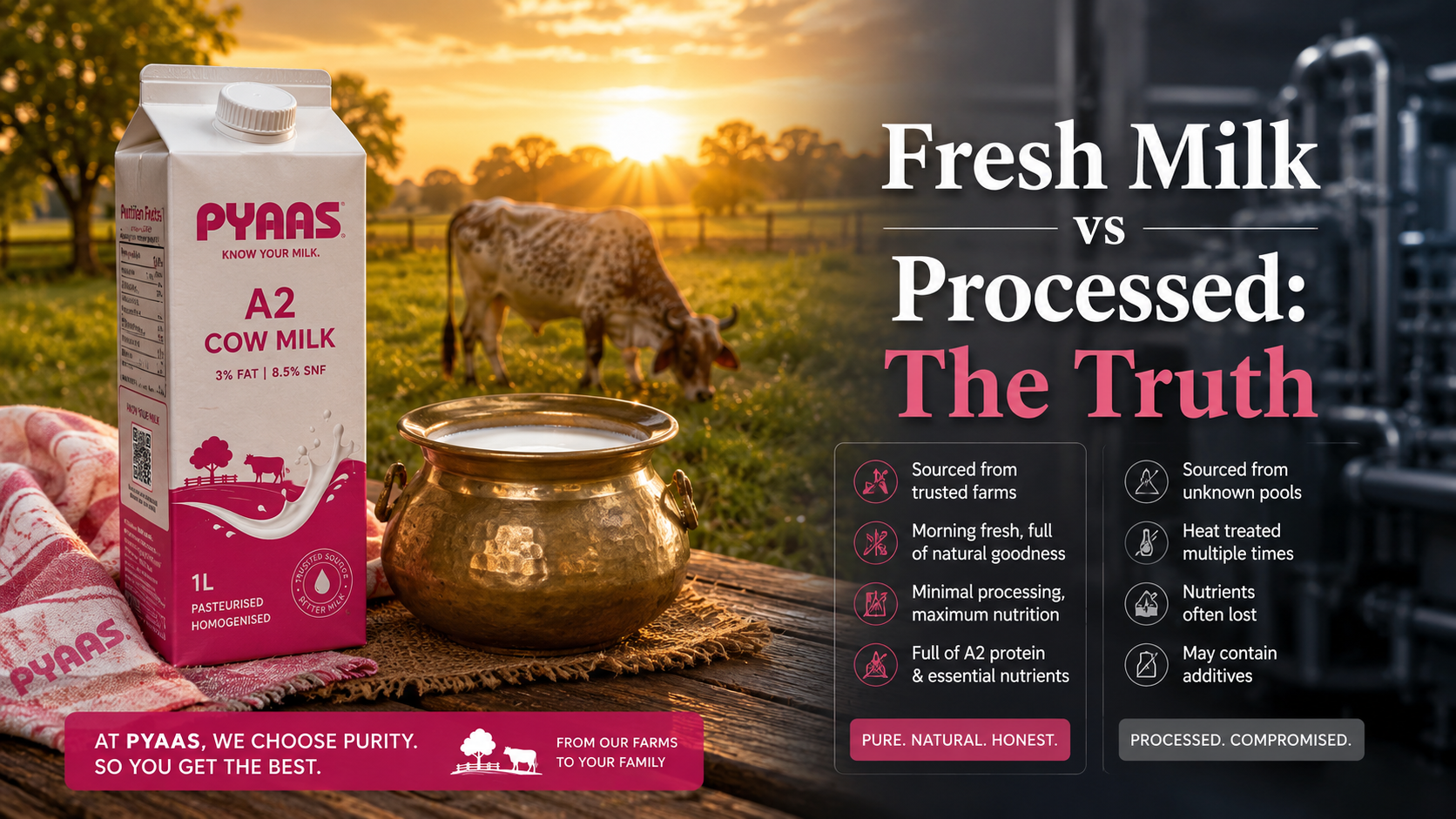
Longer shelf life and true freshness pull in opposite directions. UHT milk is a genuine marvel of convenience and will outlast almost anything else in your kitchen, but that durability comes from taking the milk further from its natural state. Fresh milk asks a little more of you: keep it cold, drink it sooner. What it gives back is milk that tastes of the farm it came from rather than the factory it survived.
So when people ask me how to compare fresh milk vs processed milk, I tell them to stop reading the front of the pack and ask these questions instead:
- How many hours ago was this milk actually in the cow?
- How far did it travel, and was it kept cold the whole way?
- Can the brand tell you the exact farm it came from?
- Was it heated just enough to be safe, or hard enough to last for months?
How we think about it at PYAAS
Our whole promise at PYAAS is Know Your Milk, so I am not going to pretend freshness is magic or that processing is the enemy. Our approach is to shorten the distance and then open the box. When our fresh A2 cow milk launches in Lucknow from August 2026 and expands across Uttar Pradesh from there, it will come from named farms in Gonda, like Sri Radha Mohan Dairy Farm, where the farmer Ram looks after the herd. Every pack will carry a QR code that opens the farm, the farmer and that batch's quality record.
Until that milk is in your hands, our A2 Bilona ghee is already shipping across India, made under the same rule: you should be able to see where it came from, not just take my word for it.
Fresh milk versus processed milk was never really a fight between good and bad. It is a question of how much distance you are willing to put between the cow and your kitchen, and how much of that distance a brand is willing to show you. My hope for PYAAS is that before long you will not have to guess about any of it. You will simply scan, see, and pour.
Written by
Aryan Sharma
Aryan Sharma is the Founder & CEO of PYAAS, an independent, transparency-first dairy brand based in Gonda and Lucknow, Uttar Pradesh. Every PYAAS pack is traceable to its farm by QR — Know Your Milk.
More from Aryan SharmaCommon questions.
Is processed milk bad for you?
No. Pasteurising milk is a genuine safety step, and processing is a big part of why milk can travel and keep. The fresh milk vs processed milk question is not about safe versus unsafe; it is about how close the milk in your glass still is to the way it left the cow. Fresher milk, handled gently, simply tends to taste cleaner and behave more naturally.
What is the difference between fresh milk and UHT milk?
UHT (ultra-high-temperature) milk is heated very hard so it can sit unopened on a shelf for months without a fridge. That durability is convenient, but it takes the milk further from its fresh state and often leaves a faintly cooked taste. Fresh milk is minimally processed, kept cold and meant to be drunk sooner, which keeps it closer to how it left the farm.
When will PYAAS fresh milk be available?
PYAAS fresh A2 cow milk launches in Lucknow from August 2026 and will expand across Uttar Pradesh from there. It will come from named farms in Gonda, and every pack will carry a QR code that opens the farm, the farmer and that batch's quality record. Our A2 Bilona ghee already ships across India today.
Get the next one in your inbox.
The occasional note on milk, ghee, and how we work. Plain words, no hype, and you can leave any time.
Keep reading.
Milk Protein Explained: Casein and Whey
4 October 2026
Milk for Healthy Skin: What Actually Helps
4 October 2026
Milk and Cholesterol: Separating Fact From Fear
4 October 2026
How to Make Khoya (Mawa) at Home
3 October 2026