How to Make Khoya (Mawa) at Home
Behind almost every beloved Indian mithai, from gulab jamun to barfi to peda, sits one humble ingredient: khoya, also called mawa. It looks simple, and it is, yet it carries the whole richness of the sweet on its shoulders. The best part is that you do not need a halwai's skill to make it. If you know how to make khoya at home, you can control its freshness, its purity and its taste completely, and it all begins with a single ingredient, milk.
What khoya actually is
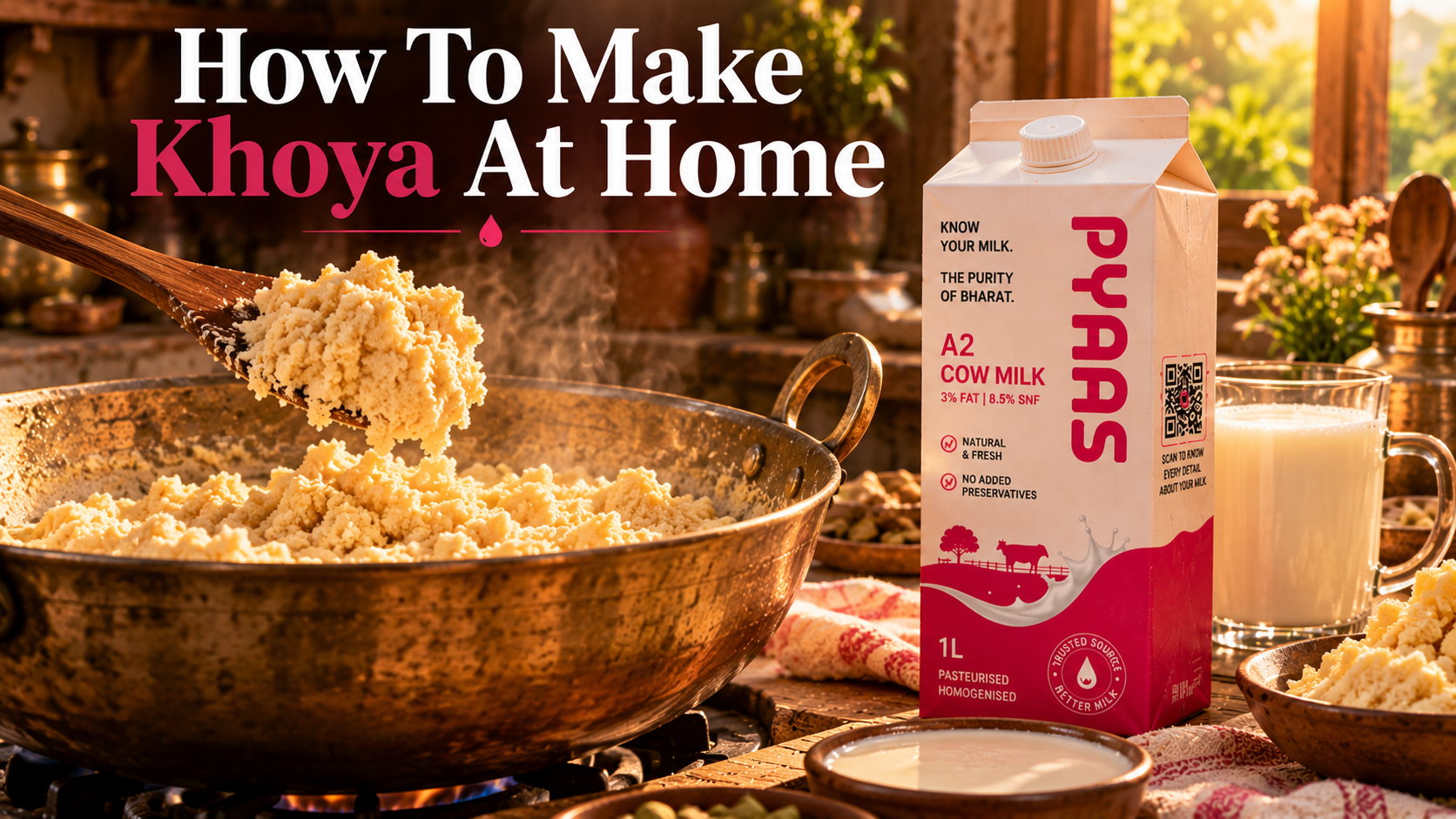
Khoya is nothing more than milk with almost all of its water cooked away, leaving behind the concentrated milk solids. That is the entire secret. When you patiently simmer full-fat milk until it thickens and dries into a soft, dough-like mass, you have made khoya. Because it is milk reduced to its essence, the milk you start with decides everything about the khoya you end with.
What you need
- Full-fat, fresh milk, about one litre to start (this yields roughly 180 to 200 grams of khoya).
- A heavy-bottomed kadai or non-stick pan, which prevents scorching.
- A sturdy spatula for constant stirring.
- Patience, which is the real ingredient.
That is it. No sugar, no additives, nothing else. Real khoya is single-ingredient food.
Step by step: how to make khoya
Here is the classic stovetop method, broken down simply.
- Boil the milk: Pour the full-fat milk into your heavy pan and bring it to a boil on medium-high heat, stirring so it does not stick.
- Reduce and stir: Lower the heat to medium and let the milk simmer, stirring frequently and scraping the sides and base. As the water evaporates, the milk will thicken steadily.
- Watch it transform: After a while it becomes grainy and paste-like. Keep stirring almost constantly now, because this is when it can catch and burn.
- Reach the right stage: When the mixture pulls away from the sides into a soft, thick lump that leaves the pan clean, your khoya is ready.
- Cool it down: Turn off the heat and let it cool. It will firm up as it sits.
The whole process is unhurried, often taking a good while, but the transformation from thin milk to rich khoya is genuinely satisfying to watch.
Tips to get it right
- Use the heaviest pan you have; thin pans scorch the milk and give a burnt taste.
- Keep the heat moderate once it thickens, and never walk away in the final stretch.
- Stir in a figure-eight motion, scraping the base, so nothing settles and burns.
- If you want softer khoya for gulab jamun, stop a touch earlier; for firmer khoya for barfi, cook a little longer.
What to make with your khoya
Fresh homemade khoya is a passport to a whole world of sweets and dishes.
- Barfi, peda and kalakand.
- Gulab jamun, when mixed with a little flour.
- Rich gravies like a khoya matar or a shahi paneer base.
- Stuffings for gujiya, modak and festive parathas.
Because you made it yourself, you know exactly what is in it, which matters more than most people realise.
Why milk quality decides everything
Here is the honest heart of it. Khoya is milk concentrated many times over, which means it also concentrates whatever is in that milk, good or bad. Start with rich, full-fat, unadulterated milk and you get fragrant, creamy khoya with real body. Start with watered-down or adulterated milk and you get a poor, dry, disappointing result, no matter how well you stir. Store-bought khoya is also, sadly, a common target for adulteration, which is another reason making it at home from milk you trust is so worthwhile. If you buy loose milk, it is worth learning how to check milk purity at home before you begin, and understanding what is really inside your glass of milk helps too.
The PYAAS connection
Everything PYAAS believes comes down to this single point: what you make is only as honest as the milk you start with. Our fresh A2 cow milk launches in Lucknow from August 2026 and will expand across Uttar Pradesh, drawn from named partner farms in Gonda, and every pack will carry a QR code you scan to see the exact farm, the farmer, and that batch's quality-checked record, our Know Your Milk promise. When you make khoya from milk you can trace, the sweet you serve your family carries that trust all the way through.
And if reducing milk down to its solids interests you, you might enjoy the next step: turning cream into golden ghee. Our A2 Bilona cow ghee already ships across India today in small batches, made from that same carefully sourced milk, and you can read how ghee is made from fresh milk to golden ghee to see the parallel craft.
The honest bottom line
Learning how to make khoya at home is really about learning that great sweets begin with great milk. The method is simple: simmer full-fat milk patiently until its solids come together into a soft, rich mass. But the quality of that first ingredient is what separates ordinary khoya from unforgettable khoya. Start with fresh, honest milk you can trace, stir with a little patience, and the mithai will take care of itself.
Written by
Aryan Sharma
PYAAS is an honest, traceable Indian dairy brand from Gonda, Uttar Pradesh.
More from Aryan SharmaCommon questions.
How much khoya does one litre of milk make?
Roughly one litre of full-fat milk yields about 180 to 200 grams of khoya, though it varies with the milk's fat content and how far you reduce it. Richer, full-fat milk gives more khoya and a better texture. This is exactly why learning how to make khoya starts with choosing good milk.
Which milk is best for making khoya at home?
Full-fat, fresh milk works best because khoya is essentially milk reduced down to its solids, so the more fat and solids the milk has, the richer your khoya. Toned or diluted milk gives a poorer, drier result. Fresh, unadulterated milk from a source you trust makes the biggest difference to the final taste.
How long does homemade khoya last?
Homemade khoya keeps for about three to four days in the fridge in an airtight container, and can be frozen for a few weeks. Because it has no preservatives, use it while fresh. Let it cool fully before storing, and thaw frozen khoya in the fridge before using it in sweets.
Get the next one in your inbox.
The occasional note on milk, ghee, and how we work. Plain words, no hype, and you can leave any time.