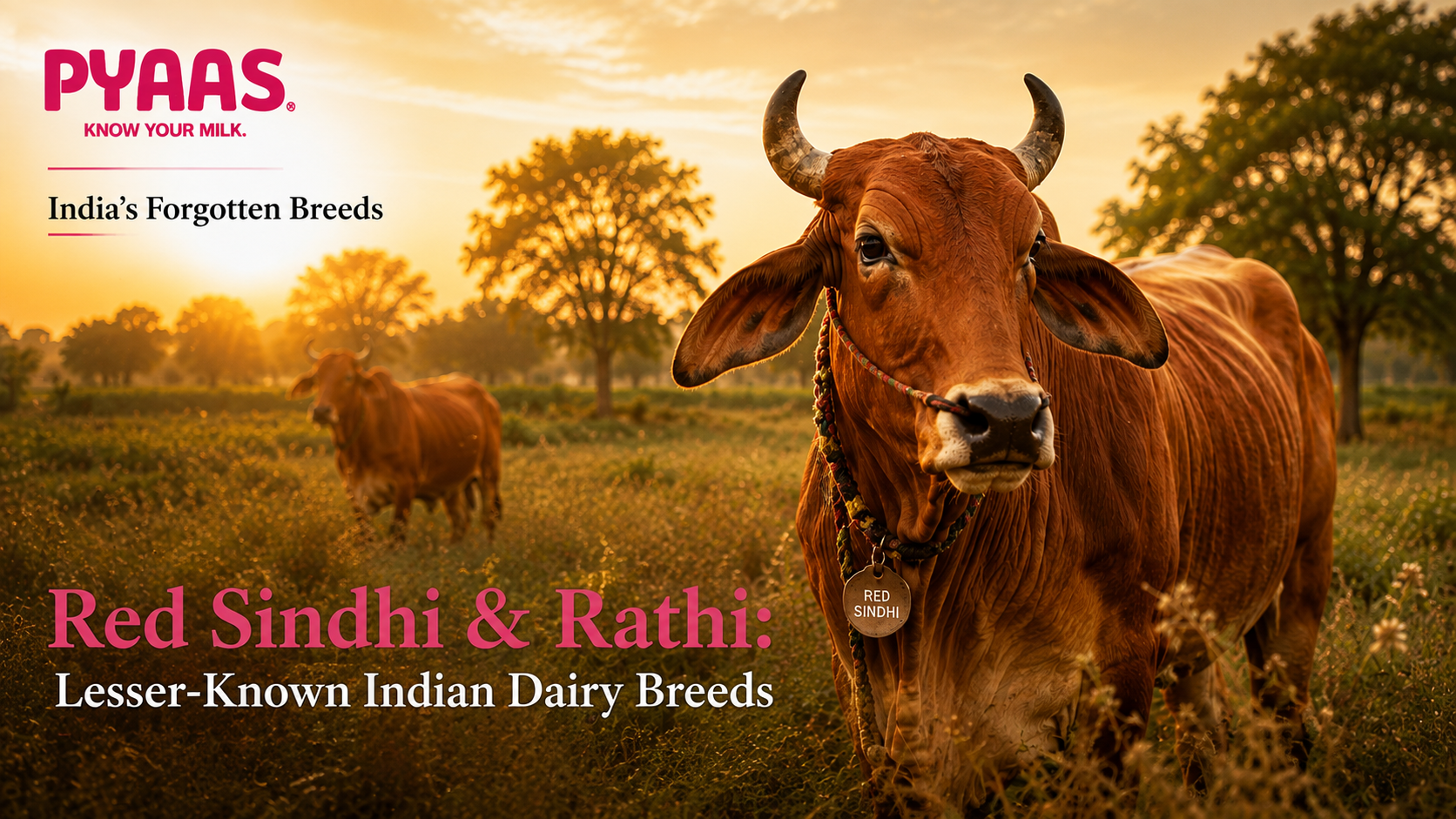
Ask most people to name an Indian cow breed and you will hear Gir, maybe Sahiwal if they follow dairy closely. But India's cattle heritage runs far deeper than the headline names, and some of its most resilient animals rarely get a mention. Two of them deserve a proper introduction: the Red Sindhi and Rathi cow, hardy indigenous breeds that quietly keep milk flowing in some of the country's toughest conditions.
Why the lesser-known breeds matter
India is home to a remarkable range of indigenous zebu cattle, each shaped over generations by a specific climate, terrain and way of life. As dairy modernises and high-yield foreign breeds spread, many of these local breeds slip quietly toward the margins. That is a loss worth taking seriously, because these animals carry genetic hardiness, disease resilience and adaptation that no spreadsheet can quickly recreate. Celebrating breeds like Red Sindhi and Rathi is not nostalgia, it is conservation of a living resource.
Meet the Red Sindhi
The Red Sindhi is one of India's best-known dairy zebu breeds among farmers, even if the general public rarely hears of it. Originally associated with the Sindh region, it has spread widely across the subcontinent thanks to a reputation for reliability. A few things stand out about the Red Sindhi:
- Distinctive colour. A deep red to reddish-brown coat gives the breed its name and its striking look.
- Heat tolerance. Like many indigenous cattle, it copes well with high temperatures and humid conditions that stress exotic breeds.
- Hardiness. Known for resilience and the ability to do well on modest resources, which makes it valuable for smallholders.
- Dependable milker. Respected as a steady dairy animal rather than a record-breaking one, prized for consistency.
Meet the Rathi
The Rathi hails from the arid stretches of Rajasthan and is sometimes called the pride of that dry region for good reason. In a landscape where water and fodder are scarce, the Rathi earns its keep. Its notable traits include:
- Desert adaptation. Built to thrive in hot, dry conditions where many breeds would falter.
- Good milk yield for its environment. Regarded as one of the more productive indigenous breeds relative to the harshness of where it lives.
- Efficiency. Able to convert sparse grazing into steady milk, a quality that matters enormously to rural families.
- Gentle temperament. Generally docile and manageable, which suits smallholder and family farming.
Both breeds share a common thread: they are survivors, tuned by generations to Indian conditions in a way that imported high-yield cattle simply are not.
The A2 connection, told honestly
You will often read that indigenous Indian cows are A2 cows, and there is a grain of truth in it. Many desi zebu breeds, Red Sindhi and Rathi among them, tend to carry the A2 beta-casein gene more commonly than some exotic breeds. But here is the honest caveat that a lot of marketing skips: A2 is a per-animal genetic trait, not a breed guarantee. You cannot assume every Red Sindhi or every Rathi produces A2 milk simply because of her breed. The only truthful way to claim A2 is to identify A2 cows individually, one animal at a time. That is exactly why PYAAS never says a whole herd or breed is all A2. If you want the underlying science, our guide on what A2 milk is and how it differs from regular milk explains it clearly.
Where PYAAS fits in
To be transparent, Red Sindhi and Rathi are not the breeds in our own partner herds. PYAAS works with named farms in Gonda, Uttar Pradesh, whose herds are Holstein Friesian and Sahiwal, and our A2 milk comes from the individually identified A2 cows within those herds. We are highlighting Red Sindhi and Rathi here not because we sell their milk, but because understanding India's breed diversity is part of understanding milk honestly. The Sahiwal, one of our own herd breeds, is itself a celebrated indigenous breed, and you can read about it in our profile of the Sahiwal cow.
Why conservation is a dairy issue
The case for protecting breeds like Red Sindhi and Rathi is practical, not sentimental:
- Genetic diversity is insurance against disease and a changing climate.
- Local adaptation means lower input costs and greater resilience for farmers.
- Traditional knowledge tied to these breeds disappears if the breeds do.
A dairy culture that knows and values its own animals is a healthier one, and it aligns naturally with the idea that you should be able to know your milk in the first place. Our piece on what Know Your Milk really means ties that thread together.
The honest bottom line
The Red Sindhi and Rathi cow may not headline the A2 marketing you see, but they are quiet pillars of India's dairy heritage, hardy, adaptable and worth conserving. They also carry an important lesson: breed can hint at A2 tendency, but only individual identification can honestly confirm it. That is the standard PYAAS holds itself to. Whether the milk comes from a Sahiwal in Gonda or a Rathi in the Rajasthan desert, honest dairy starts with knowing the animal, not just the label on the pack.
Health articles are general information, not medical advice. Talk to your doctor about your own diet.
Common questions
Are Red Sindhi and Rathi cows A2 breeds?
Many indigenous zebu cows, including Red Sindhi and Rathi, tend to carry the A2 beta-casein gene, but A2 is a per-animal trait, not a whole-breed guarantee. You cannot assume every individual is A2 based on breed alone. Honest A2 sourcing means identifying A2 cows one by one, whatever the breed.
Why are the Red Sindhi and Rathi cow breeds important?
Red Sindhi and Rathi are hardy indigenous breeds well suited to India's heat and harsher conditions, and they sustain many rural families with reliable milk. Conserving them protects genetic diversity and traditional dairy knowledge. As farming industrialises, these lesser-known breeds risk being overlooked, which is why awareness matters.
Does PYAAS use Red Sindhi or Rathi cows?
PYAAS partners with named farms in Gonda whose herds are Holstein Friesian and Sahiwal, and our A2 milk comes from the individually identified A2 cows within those herds. Red Sindhi and Rathi are not our herd breeds, but they are an important part of India's wider indigenous dairy heritage worth celebrating.
One guide a week, on WhatsApp
Short, plain, no spam. Stop any time by replying STOP.