
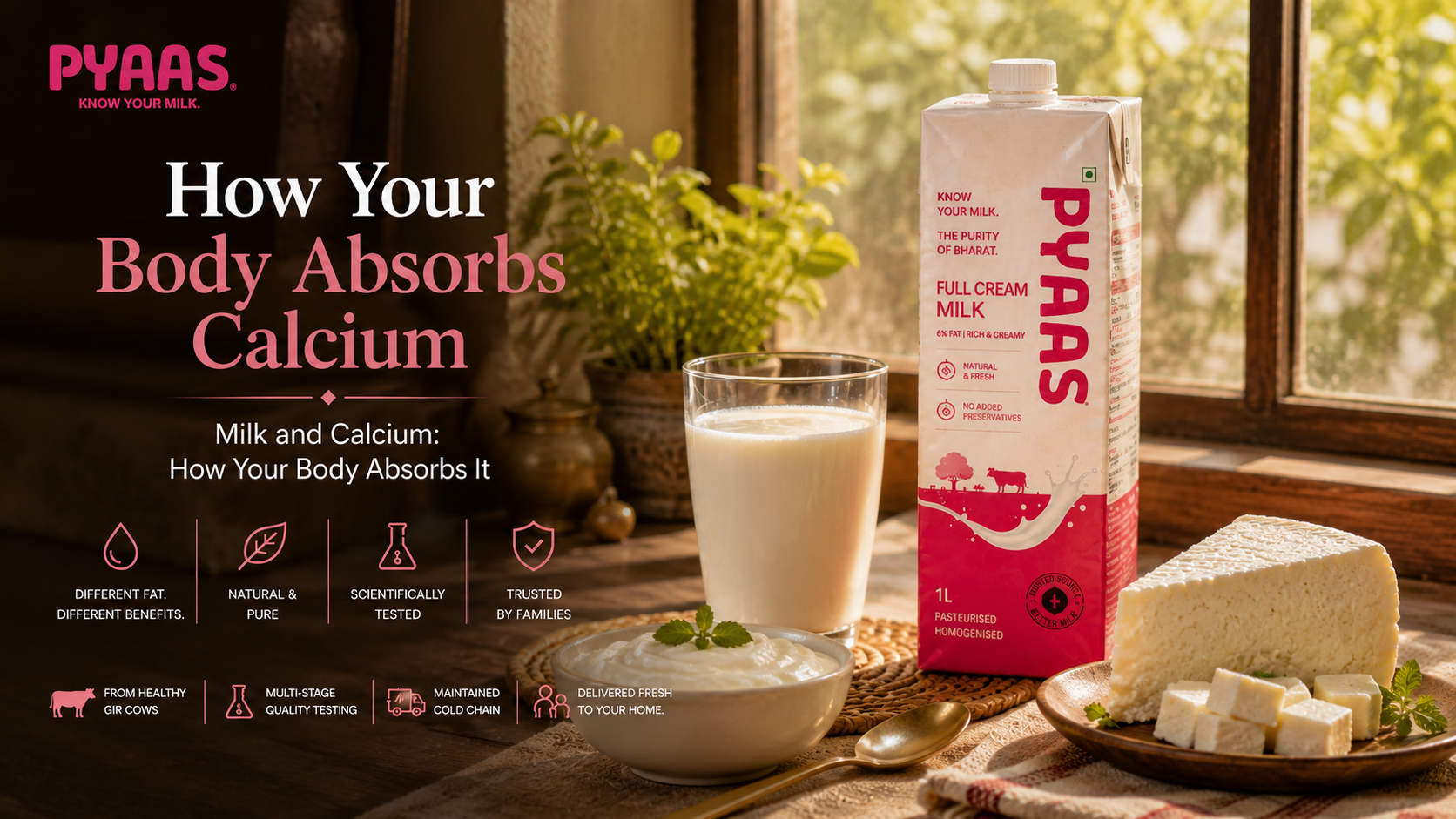
Ask almost anyone in India where to get calcium and the answer arrives instantly: milk. It is one of the few pieces of nutrition advice that has survived generations without much argument. But the honest, more interesting truth is that drinking calcium and absorbing it are two different things. Understanding milk calcium absorption tells you far more about your bones than any number printed on a carton.
What is actually in the glass
A single cup of cow milk carries roughly 275 to 300 mg of calcium. For most adults, two servings of dairy cover a big share of the day's requirement. But raw quantity is not the whole story. What makes milk special is not just how much calcium it holds, but how readily your body can take that calcium in.
Calcium from milk is absorbed efficiently, and a good part of the reason is the company it keeps. In milk, calcium travels alongside casein protein and a little natural fat, and it arrives with some vitamin D. This packaging is not an accident; it is how nature bundles a mineral so the body can actually use it.
Vitamin D: the quiet partner
Here is the fact that reframes everything. Your gut cannot absorb calcium well without vitamin D. Think of vitamin D as the doorkeeper that lets calcium cross from your intestine into your blood. You can eat plenty of calcium, but if vitamin D is low, much of it simply passes through.
Your body makes its own vitamin D when sunlight hits your skin, which is one reason a morning walk matters as much as a glass of milk. Milk contributes some vitamin D too, so the two nutrients reinforce each other. This partnership is why doctors so often check calcium and vitamin D together rather than one alone.
What can get in the way
Absorption is not guaranteed, and a few everyday things nudge it up or down:
- Vitamin D status: the single biggest factor in how much calcium you actually keep.
- Very high salt and caffeine: in large amounts these can increase how much calcium you lose through urine.
- Overall diet balance: a diet with enough protein and a spread of vegetables supports bone health better than calcium in isolation.
- Age and life stage: children, pregnant and breastfeeding women, and older adults have higher needs and sometimes different absorption.
None of this means milk is unreliable. It means calcium works as part of a system, and milk happens to be one of the most convenient, well-absorbed entry points into that system.
Milk versus other calcium sources
Plenty of Indian foods carry calcium: sesame, ragi, curd, paneer, leafy greens and small fish among them. What sets milk apart is the combination of a high dose and high absorbability in one easy glass. Some plant sources contain compounds like oxalates that bind calcium and lower how much you absorb, so the number on paper can overstate what your body receives. Milk does not have that problem to the same degree.
This is also where curd and paneer earn their place. When milk becomes curd, much of the calcium stays with the casein, and the fermentation can make it sit easier for people who feel heavy on plain milk. If you are curious about the full nutritional make-up of dairy, our breakdown of what is really inside your glass of milk goes deeper.
Does A2 milk change calcium absorption?
This is a common question, and the honest answer is that A2 milk is not primarily a calcium story. The A1 and A2 difference sits in the beta-casein protein, not in the mineral content. The calcium in A2 milk is broadly the same as in ordinary milk. Where some people notice a difference is comfort: many find A2 milk easier to digest, which can simply mean they keep drinking it consistently, and consistency is what actually builds a calcium habit. We explain what A2 does and does not do in our A2 milk guide, without the usual hype.
Bone health is a whole-life project
It would be easy to end here with "drink more milk". But that would not be honest. Strong bones are built by calcium, vitamin D, adequate protein, and weight-bearing movement like walking, climbing stairs or lifting. Milk supports several of those at once, which is genuinely valuable, yet it is a contributor, not a cure. If you have a specific concern about bone density, deficiency or a medical condition, the right move is a conversation with your doctor and, where needed, a blood test, not a change of milk brand.
Small habits that help calcium land
- Pair your milk habit with some daily sunlight for natural vitamin D.
- Keep protein adequate across the day; bones are a protein matrix, not just minerals.
- Move your body; bone responds to being used.
- Choose fresh, well-handled milk you can trust, so what you drink is what the label promises.
Why trust in the source still matters
Absorption science assumes one thing: that the milk in your glass is genuinely what it claims to be. Watered-down or adulterated milk quietly undercuts every calcium calculation you make. This is exactly why PYAAS puts a scannable QR code on every pack, linking to the farm, the farmer and the batch's quality-checked record. You cannot absorb calcium from milk that was never really milk.
So the takeaway is gentle and honest. Milk is one of the easiest, most efficient calcium sources available to an Indian family, and its calcium is absorbed well when vitamin D and a balanced diet are in place. Drink it as part of a real life of sunlight, movement and varied food, and choose milk you can actually trace back to its source. That is milk and calcium working the way they are meant to.
Health articles are general information, not medical advice. Talk to your doctor about your own diet.
Common questions
How much calcium does a glass of milk give you?
A cup of cow milk provides roughly 275 to 300 mg of calcium, a large share of a day's needs for most people. Just as important, milk calcium absorption is efficient because the calcium comes packaged with protein and vitamin D that help your body take it in.
Do I need vitamin D for calcium to work?
Yes. Vitamin D is the key that lets your gut absorb calcium properly. Milk supplies some, and sunlight helps your body make its own. Without enough vitamin D, even a calcium-rich diet is only partly used, which is why doctors look at both together.
Does drinking more milk always mean stronger bones?
Not on its own. Bone health depends on calcium, vitamin D, protein, physical activity and overall diet working together. Milk is a genuinely convenient source of well-absorbed calcium, but it is one part of the picture, not a guarantee. Speak to a doctor about your own needs.
One guide a week, on WhatsApp
Short, plain, no spam. Stop any time by replying STOP.