What is Bilona ghee
Bilona is one of the most stretched words in Indian dairy. It is used to mean premium, traditional, or simply expensive. In its real sense it describes a specific way of making ghee that starts from curd rather than cream. This guide walks through the actual method, why it costs more, and how to read a label without being fooled.
The bilona method, step by step
The traditional bilona route does not start with cream. It starts with whole milk that is cultured into curd. That curd is then churned, the old way using a wooden churner called a bilona, until butter separates out. The butter is gently simmered into ghee.
The sequence matters. Milk becomes curd, curd is churned into butter, and butter is clarified into ghee. Because the milk is fermented first, the process is slower and yields less ghee per litre than shortcut methods. That slowness is the point, not a flaw.
How it differs from ordinary ghee
Most commodity ghee is made directly from cream or from collected milk fat, skipping the curd stage entirely. It is faster and cheaper and gives more ghee per litre. The curd-first bilona method is the older, more labour-heavy approach, and many people prefer its aroma and texture.
We will be honest about the claims here. There is genuine craft and tradition in the bilona method, and a real difference in how it is made. The grand health claims that often ride alongside it are far less settled. What you can rely on is the method and the source, so that is what we focus on.
The method is only half of it
Bilona describes what happens after the milk arrives. It says nothing about the milk itself. You can run the bilona method on milk pooled from hundreds of unnamed sources and still call the result bilona ghee, because the word is about the churn, not the source.
So treat them as two separate questions. How was it made, and what was it made from. A maker who can answer only the first is telling you half a story. Our answer to the second is four named partner farms in Gonda, each with a named owner, and whole milk rather than milk standardised down.
How to spot real bilona ghee
Real bilona ghee is slower to make and lower in yield, so it is rarely the cheapest jar on the shelf. Look for clarity about the source and the method, a farm that can be named rather than a region, and be wary of the word bilona used as decoration with nothing behind it.
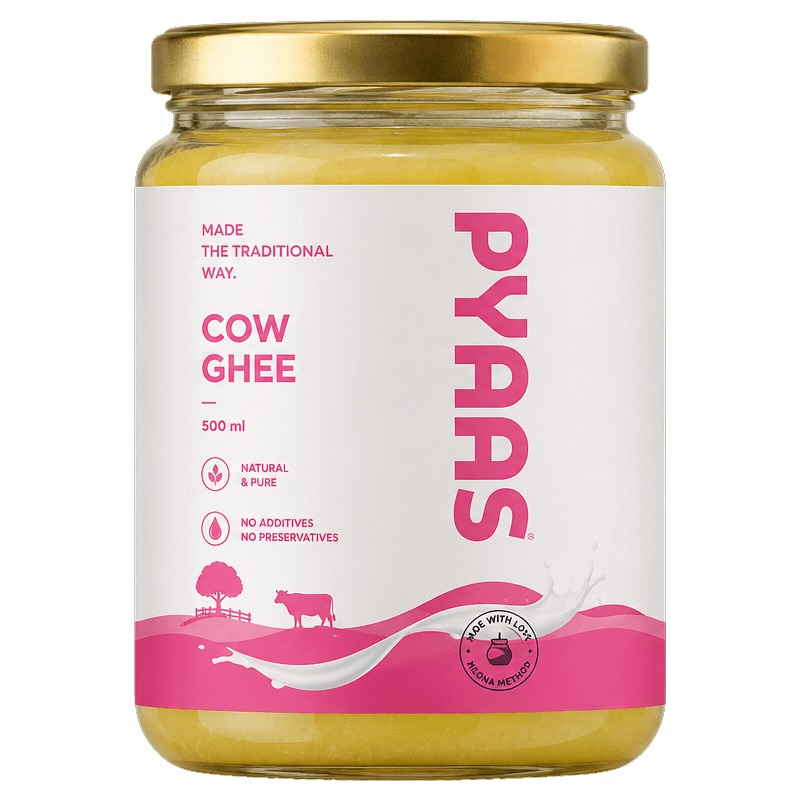
PYAAS Pure Cow Ghee is made from the milk of our named partner farms in Gonda, and every batch is checked for purity before it is packed. It is the one PYAAS product that ships across India today, while in Lucknow PYAAS Desi Gau Milk is delivered every morning by 07:00. If you want to understand our ghee before buying, this guide is exactly the homework we would want you to do.
Frequently asked questions
What does bilona mean?
Bilona refers to the traditional wooden churner and the curd-first method of making ghee. Milk is turned into curd, the curd is churned into butter, and the butter is simmered into ghee.
Is bilona ghee better than regular ghee?
Bilona ghee is made by a slower, more traditional, curd-first method that many people prefer for aroma and texture. Strong health claims around it are far less settled, so we stick to describing the method and source.
Is PYAAS ghee made the bilona way?
PYAAS Pure Cow Ghee is made the curd-first bilona way from the milk of our named partner farms in Gonda, and checked for purity every batch. It is our one fully launched, buyable product.
Why is bilona ghee more expensive?
The curd-first method takes longer and yields less ghee per litre of milk, so it costs more to make than cream-based shortcut ghee.
Taste the part we have already launched.
In Lucknow, PYAAS Desi Gau Milk is delivered every morning by 07:00, and our Pure Cow Ghee is made and buyable today, from our named Gonda farms and checked for purity every batch.