Why We Built PYAAS's Traceability Technology
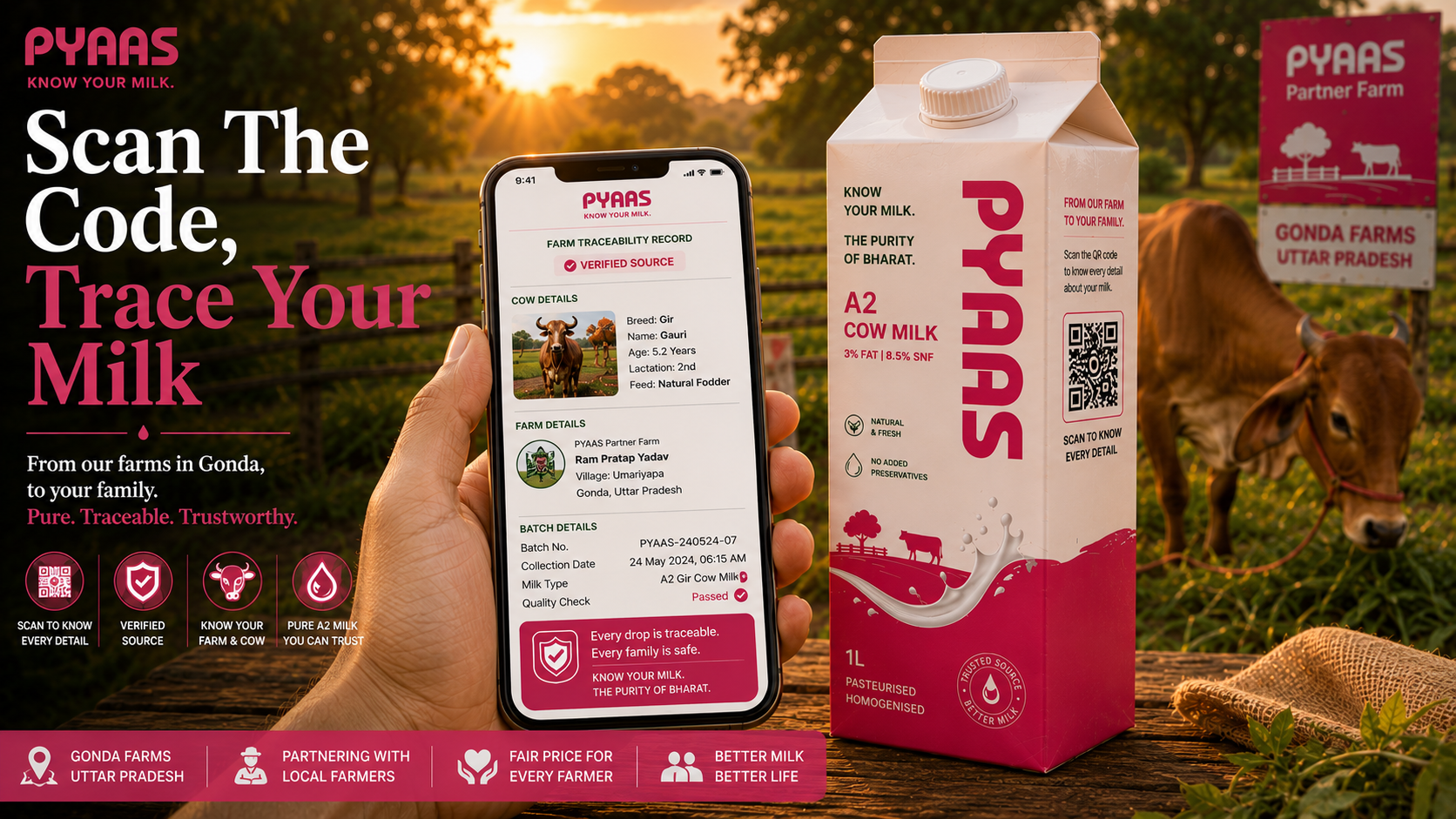
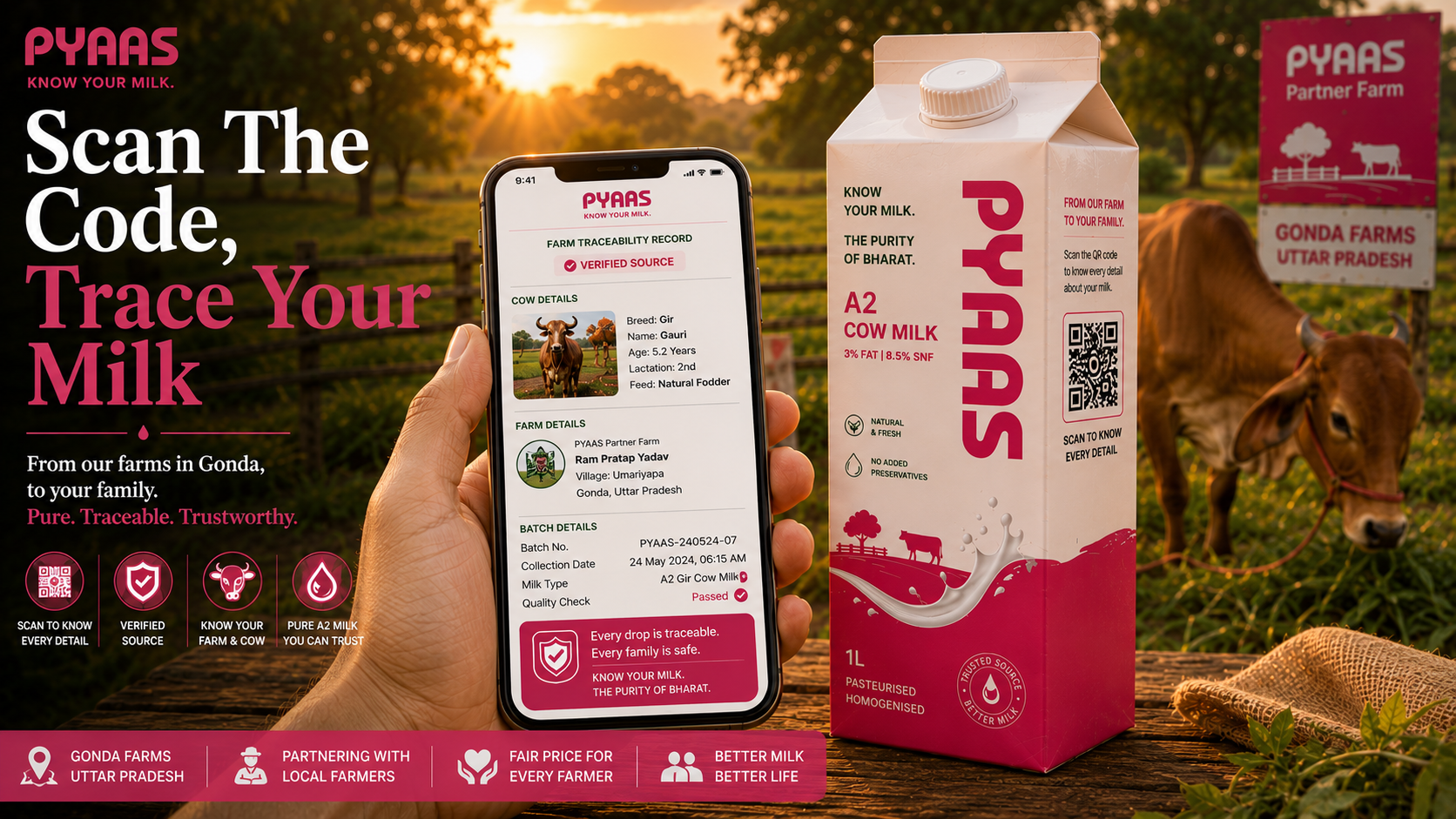
The first time I watched someone scan the QR code on a PYAAS pack and read back the name of the farmer who tends the cows, I knew we had built the right thing. I am Kushagra Shekhar Kaushik, Founder and CTO of PYAAS, and that single moment, the scan that turns a promise into evidence, is the reason our dairy traceability technology exists at all.
The problem we set out to solve
Most milk in India is pooled. It is collected from thousands of farms, mixed together, and sold under a label that tells you plenty about the brand and almost nothing about the source. The carton says pure, fresh, farm-to-home, and none of it can be checked. As someone who builds systems for a living, that gap bothered me. A claim you cannot verify is just a nicer way of saying trust me.
When Aryan Sharma and I started PYAAS, we agreed on one thing we would never compromise: we would not ask people to simply trust us. We would give them a way to check. Everything I have built on the product and technology side of PYAAS flows from that single decision.
Why a QR code, and what sits behind it
The QR code is the part everyone sees, and honestly it is the easy part. Anyone can print a QR code. The hard, valuable part is the record it points to. Behind every code on a PYAAS pack is a batch record that ties four things together:
- The farm the milk came from, by name, not a vague district.
- The farmer who tends that herd.
- The batch that pack belongs to, and when it was made.
- That batch's quality record, including the checks we run such as SNF and FAT.
So when you scan a PYAAS pack, you are not reading marketing copy. You are reading the actual record of the milk in your hand. It might come from Sri Radha Mohan Dairy Farm in Gonda, Uttar Pradesh, a herd of 76 Holstein Friesian and Sahiwal cows, or from Gonard Dairy or Ranjeet Singh Dairy Farm nearby. The name on the screen is a real place with real people.
How the batch record is built
The technology's job is to move truthful data from the farm to the pack without anyone having to remember to do it. Milk is collected from a named farm, logged against that farm and farmer at source, quality checked, and assigned to a batch. When that batch is packed, the QR code is bound to the batch record. Nothing on the pack is typed in by hand at the end to make it look good.
Designing for honesty, not decoration
Every design choice I made started with one simple test: could this be faked to flatter us? If a field could be quietly edited to say something prettier than the truth, it did not belong in the system. Good dairy traceability technology is not about dashboards and graphics. It is about making the honest answer the automatic one, and making it very hard to show anything else.
What good dairy traceability technology should never do
I have strong opinions here, because this is where a lot of traceability turns into theatre. A QR code that opens a generic brand video is not traceability. A batch page that shows the same stock farm for every product is not traceability. If the record cannot be genuinely different for two different batches, it is decoration.
We also refuse to overstate what a check proves. PYAAS milk is quality checked, and we say quality checked, not lab certified, because the words on a pack should match exactly what we can stand behind. The whole system loses its value the moment it exaggerates, even by a little.
Where we go from here
Right now our A2 Bilona ghee ships across India, and each jar carries this traceability. Fresh A2 cow milk launches in Lucknow from August 2026 and will expand across Uttar Pradesh, and the same batch record will follow every pack from day one. As PYAAS grows into the honest, transparent dairy brand we are building, the technology has one unchanging job: to keep the answer on the screen equal to the truth on the farm.
That is why we built it. Not to look modern, but to make Know Your Milk something you can do with your own thumb, in seconds, standing at your kitchen counter. If you want to see it working, scan any PYAAS pack, or explore the farms behind every batch. I am Kushagra Shekhar Kaushik, and this is the part of PYAAS I am proudest to have built.
Written by
Kushagra Shekhar Kaushik
Kushagra Shekhar Kaushik is the Founder & CTO of PYAAS, an independent, transparency-first dairy brand based in Gonda and Lucknow, Uttar Pradesh, building the technology that makes every pack traceable to its farm by QR.
More from Kushagra Shekhar KaushikCommon questions.
What is PYAAS's dairy traceability technology?
It is the system behind the QR code on every PYAAS pack. Instead of printing a claim, PYAAS ties each pack to a batch record that links the named farm the milk came from, the farmer who tends the herd, the batch and when it was made, and that batch's quality record. Scanning the code lets you read that record for yourself.
What can I see when I scan a PYAAS QR code?
You see the actual source of the milk in your hand: the named farm in Gonda, Uttar Pradesh, such as Sri Radha Mohan Dairy Farm, Gonard Dairy or Ranjeet Singh Dairy Farm, the farmer, the batch it belongs to, and that batch's quality record including checks like SNF and FAT. It is a record, not marketing copy.
Is PYAAS milk available now?
PYAAS A2 Bilona ghee ships across India today, and every jar carries this traceability. Fresh A2 cow milk is launching in Lucknow from August 2026 and will expand across Uttar Pradesh, with the same batch record following every pack from day one.
Get the next one in your inbox.
The occasional note on milk, ghee, and how we work. Plain words, no hype, and you can leave any time.
Keep reading.
Dairy 4.0: How Technology Is Modernising Indian Dairy
21 August 2026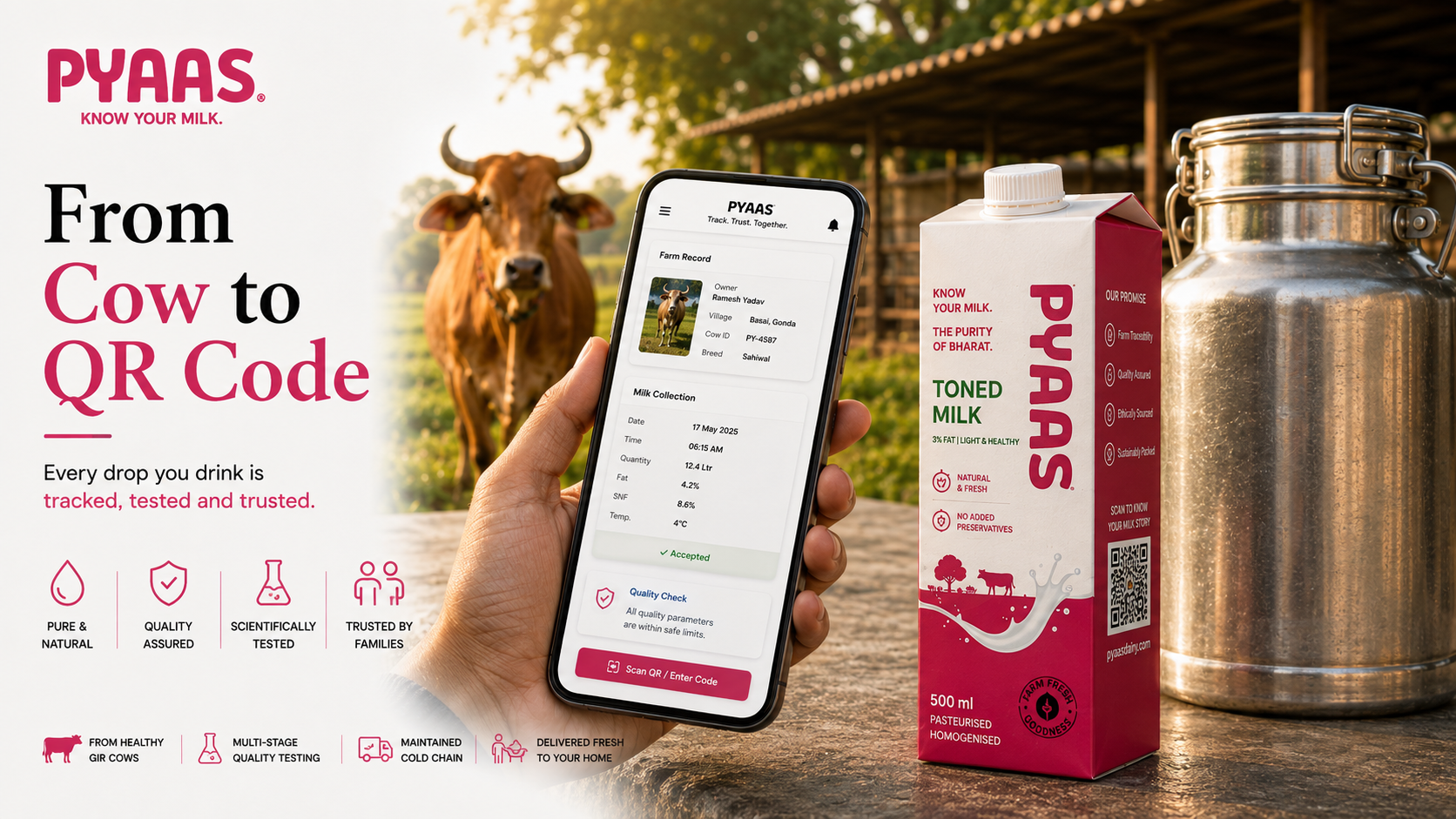
The Technology PYAAS Is Building for Parag: QR Traceability and a Modern Dairy Platform
18 August 2026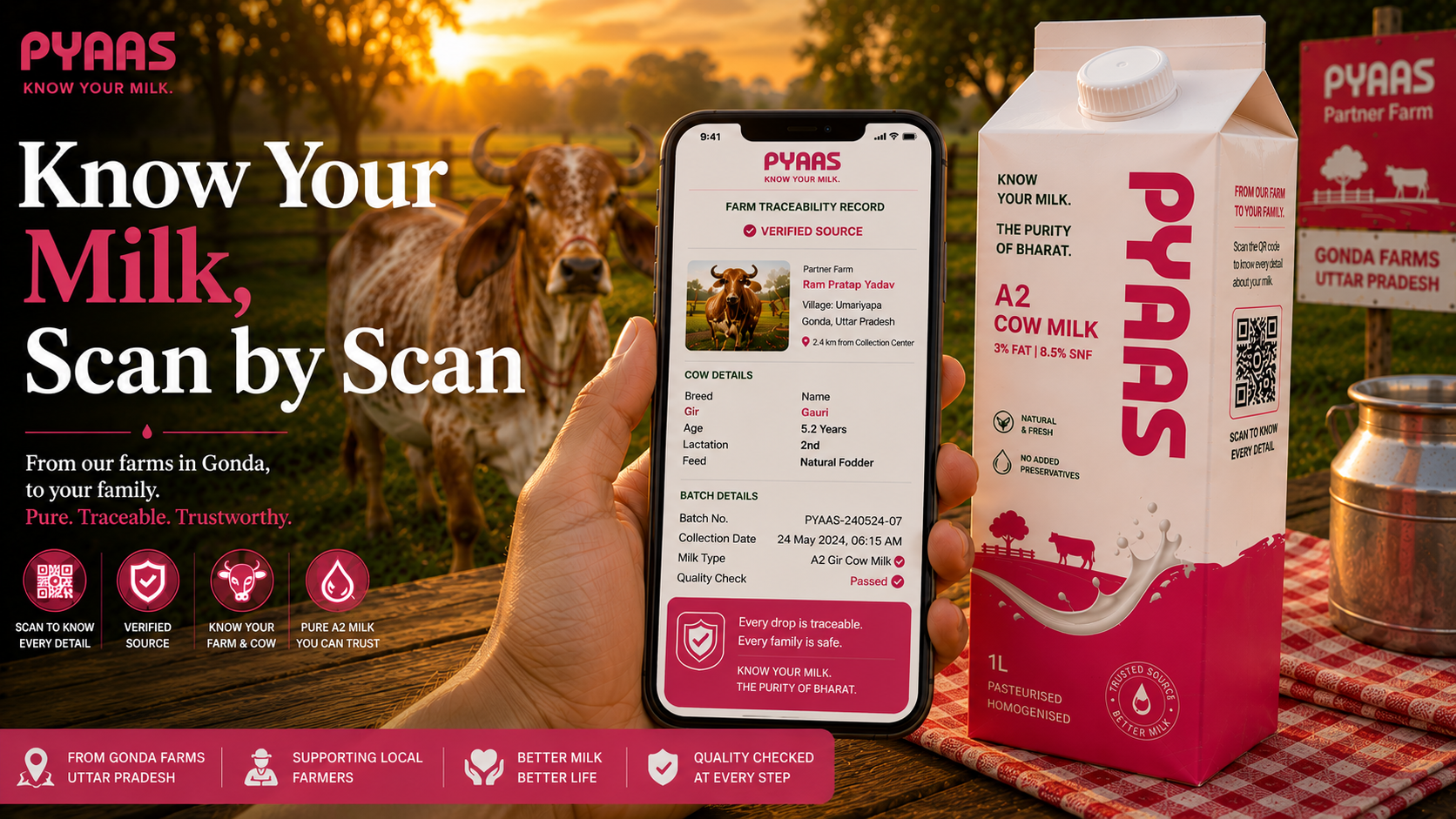
The Technology Behind 'Know Your Milk'
31 July 2026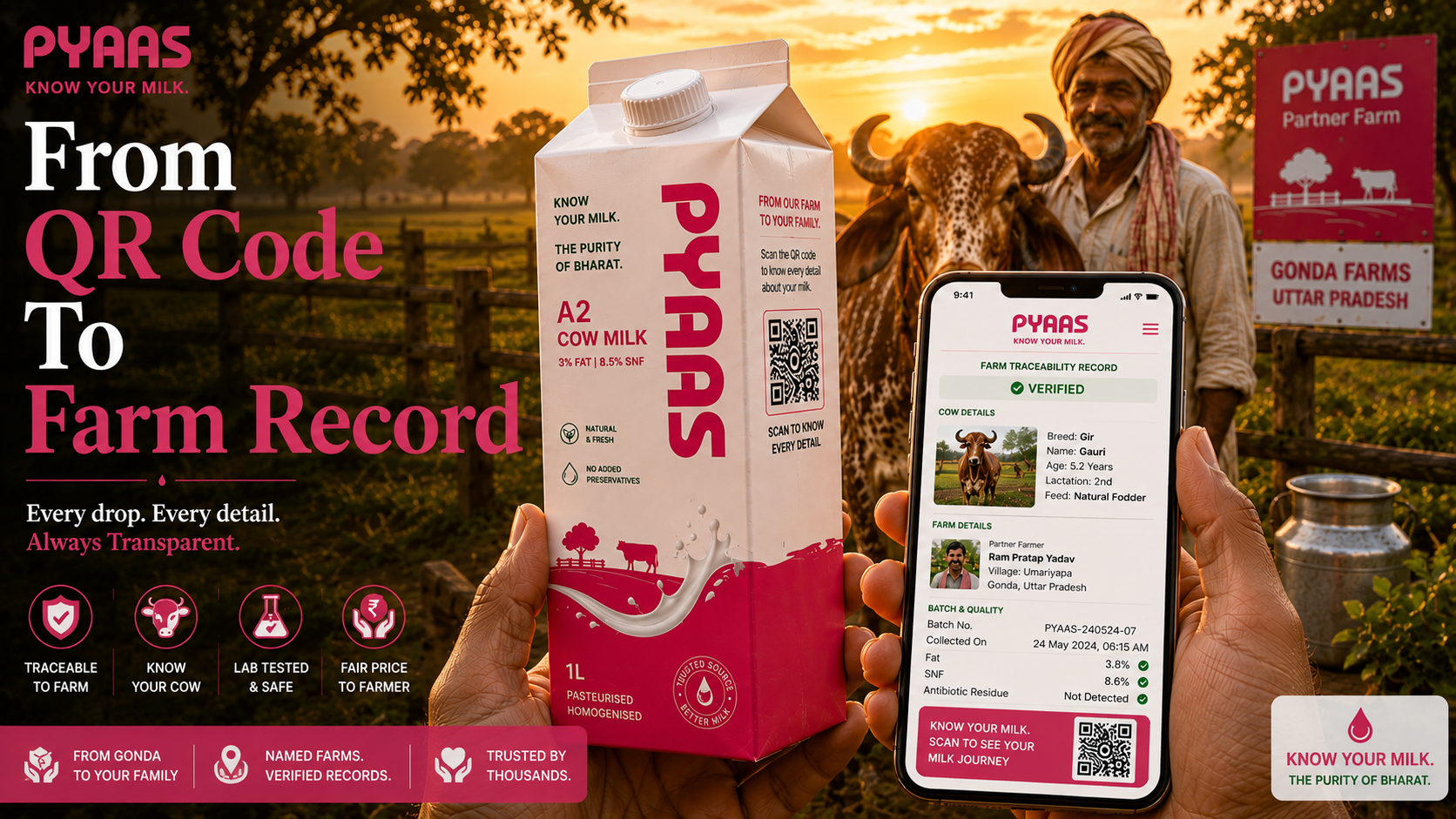
Why a Dairy Brand Needs a CTO: Aryan Sharma on Building PYAAS With Kushagra Kaushik
31 July 2026