The Technology Behind 'Know Your Milk'
Most dairy brands ask you to trust them. At PYAAS, we would rather you check. That one choice — verify, don't trust — is the reason my job exists. I am Kushagra Shekhar Kaushik, the Founder & CTO, and my work is to turn a three-word promise, Know Your Milk, into software that actually holds up the moment you scan a pack.
People assume the hard part of a dairy brand is the milk. It isn't. The hard part is memory: keeping an honest, unbroken record of where every pack came from, who produced it, and how it was checked — and then making that record something a family can open in a few seconds, not a spreadsheet locked in an office. This is a tour of the know your milk technology behind PYAAS, from the farm gate to the code on the lid.
What 'Know Your Milk' has to mean in software
A slogan is easy. Making it true in code forces you to be precise. For us, Know Your Milk reduces to three facts that must be real for every single pack: the farm it came from, the farmer who produced it, and that batch's quality record. If any one of those is guessed, averaged, or quietly filled in later, the promise is already broken — no matter how good the front of the pack looks.
That constraint rules out the thing most of the industry does by default: pooling. Conventional milk is mixed from thousands of farms before it is packed, and once it is mixed, the origin is gone forever. You cannot build a farm-level record on top of a pool. So single-origin is not a marketing line for us; it is a data rule I designed the system around. One pack maps back to one named farm, or the record does not get created.
The record starts at the farm, not the office
The most important design decision was where the data is born. If a record is typed up afterwards from memory, it is a story. If it is captured at the source, it is evidence. So the batch record begins at the farm.
Our partner farms are in Gonda, Uttar Pradesh — Sri Radha Mohan Dairy Farm with its herd of 76 cows and farmer Ram, Gonard Dairy with farmer Harsh Singh, and Ranjeet Singh Dairy Farm with farmer Ranjeet Singh. The herds are Holstein Friesian and Sahiwal, and the A2 milk comes from the A2 cows in the herd. Each batch is tied to one of these named farms and the person who actually produced it, from the moment it enters our system.
Alongside origin, the batch carries its quality record — the checks that batch passed before it went forward. I am deliberate about the language here: we say quality checked, not lab certified. The technology's job is to show you what was actually done for that batch and let you judge it, not to inflate it with words the record cannot back up.
One pack, one QR, one record you can open
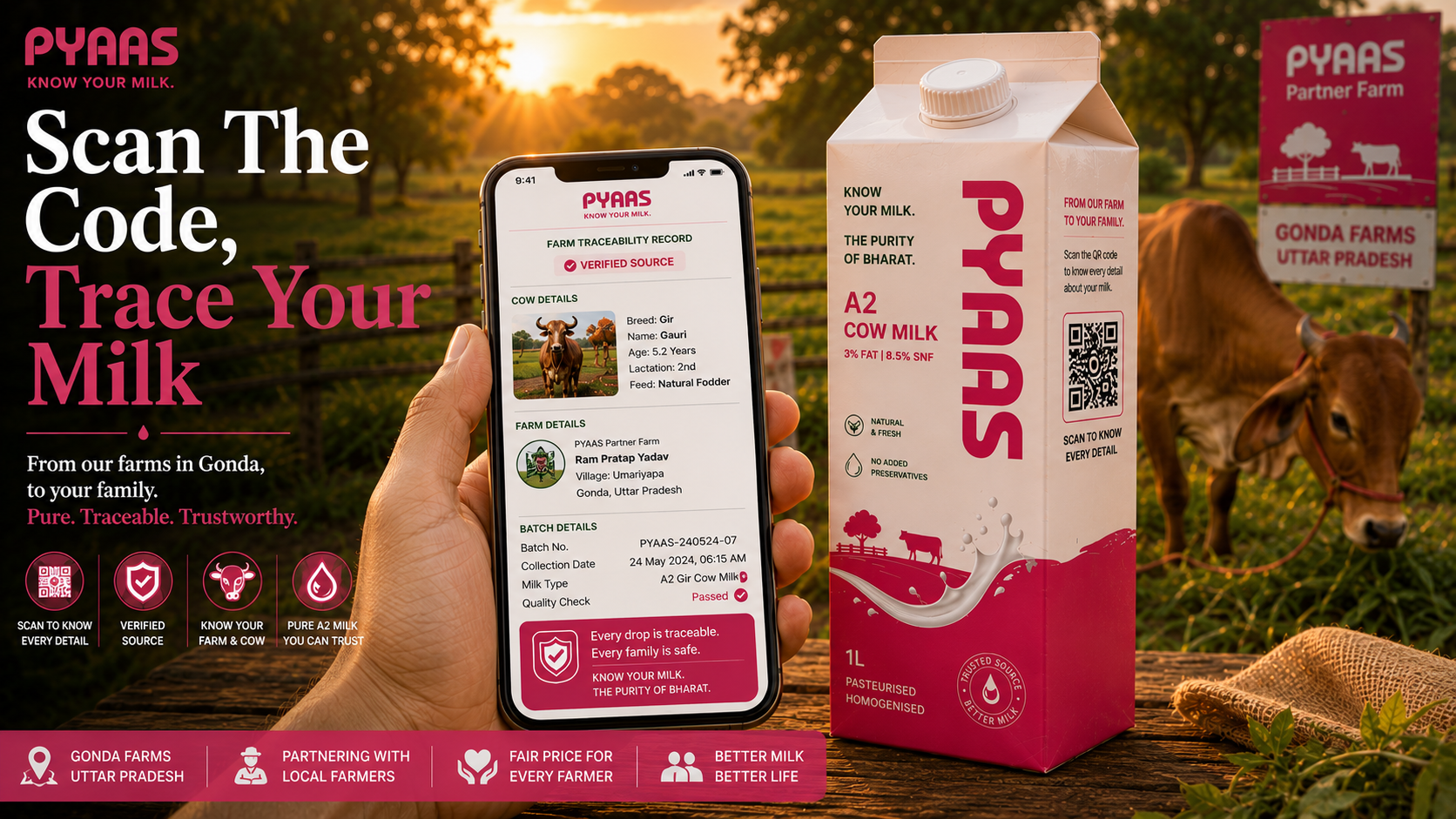
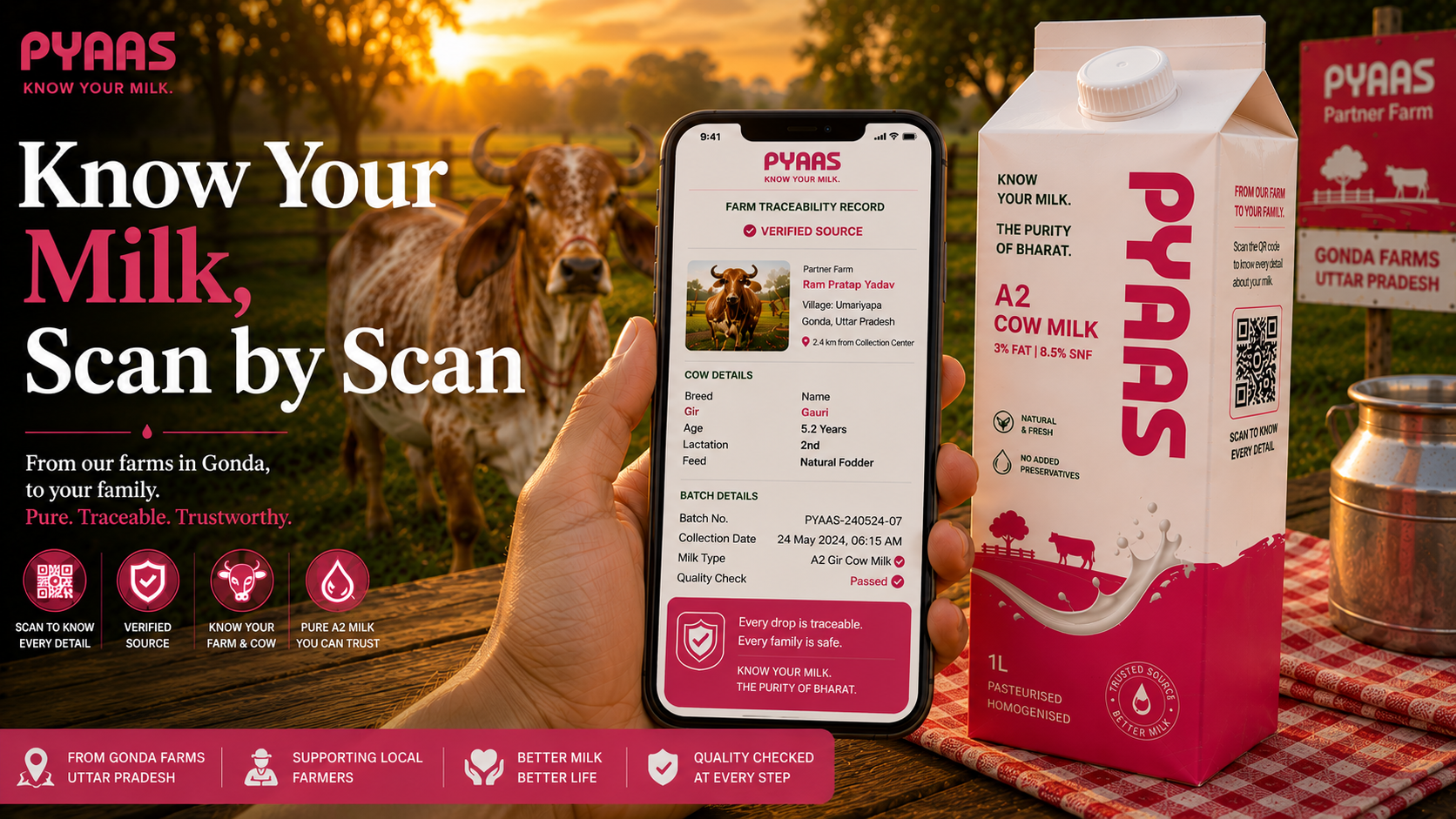
All of that only matters if a real person can reach it. So the last mile of the know your milk technology is the simplest-looking part and the one I care about most: a QR code on the pack.
Scan it and you land on the record for that specific batch — not a generic brand page, not a stock photo of a green field. You see the farm, the farmer, and that batch's quality record. It is designed to be read, not edited: the record is written once at the source, so what you scan tomorrow is the same truth that was captured on the day. Traceability is only trustworthy if history cannot be quietly rewritten to look better.
There is also a long list of things I have chosen not to build, and that list is part of the honesty. The system will never surface a claim our operations cannot support. If we cannot show it, the software does not say it. On a transparency brand, a missing field is more honest than a confident guess.
Why I chose durable, unglamorous technology
It would be easy to make a beautiful traceability demo that works for one carton on a good day. That is not the problem. The problem is a record that stays honest across thousands of packs, many farms, and years of operation — through summers, through scale, through the messy reality of a supply chain. So I optimise for durability over cleverness: a clear data model, one identity per batch, records that are cheap to write at the source and instant to read on a phone.
The same discipline is why we shipped the technology on ghee first. PYAAS A2 Bilona cow ghee is live and ships across India today, and every jar already carries this traceability. Ghee let us prove the whole chain — farm to farmer to batch record to the QR in a customer's hand — on a product that travels well, so the system is battle-tested before it has to carry something as time-sensitive as fresh milk.
What we are building toward
The next chapter is milk. PYAAS fresh A2 cow milk is pre-launch and will launch in Lucknow from August 2026, expanding across Uttar Pradesh from there. I am building the know your milk technology now, before that date, precisely so traceability ships on day one rather than as a feature we bolt on later. When the first litre reaches a home in Lucknow, the QR should already tell the full, checkable story.
My fellow founder Aryan Sharma often says the field is where trust is earned; my job is to make sure the software never spends that trust carelessly. We are building toward a ₹100 crore dairy brand, and the only version of that worth building is one where the bigger we get, the easier it becomes for a family to verify their own milk. If we ever have to hide something to grow, we have built the wrong thing. So we keep it simple, and we keep it honest: Know Your Milk — and let the record speak for itself. — Kushagra Shekhar Kaushik, Founder & CTO, PYAAS.
Written by
Kushagra Shekhar Kaushik
Kushagra Shekhar Kaushik is the Founder & CTO of PYAAS, an independent, transparency-first dairy brand based in Gonda and Lucknow, Uttar Pradesh, building the technology that makes every pack traceable to its farm by QR.
More from Kushagra Shekhar KaushikCommon questions.
What is the technology behind PYAAS's 'Know Your Milk' promise?
It is a traceability system that ties every pack to three facts: the named farm it came from, the farmer who produced it, and that specific batch's quality record. A QR code on the pack opens that record, so you are checking a source rather than trusting a slogan. This is live today on our A2 Bilona ghee, which ships across India, and the same system will carry our fresh milk when it launches.
How does the QR code on a PYAAS pack work?
Each pack carries a code linked to one batch, not a generic marketing page. When you scan it, you see the farm in Gonda, Uttar Pradesh that the batch came from, the farmer behind it, and the quality record for that batch. The record is written once at the source and is meant to be read, not edited after the fact.
Is PYAAS fresh milk available now?
Not yet. PYAAS A2 Bilona cow ghee is live and shipping across India today. Fresh A2 cow milk is pre-launch and will launch in Lucknow from August 2026, expanding across Uttar Pradesh from there. The Know Your Milk technology is being built now so that traceability ships on day one, not as a later add-on.
Get the next one in your inbox.
The occasional note on milk, ghee, and how we work. Plain words, no hype, and you can leave any time.
Keep reading.
Dairy 4.0: How Technology Is Modernising Indian Dairy
21 August 2026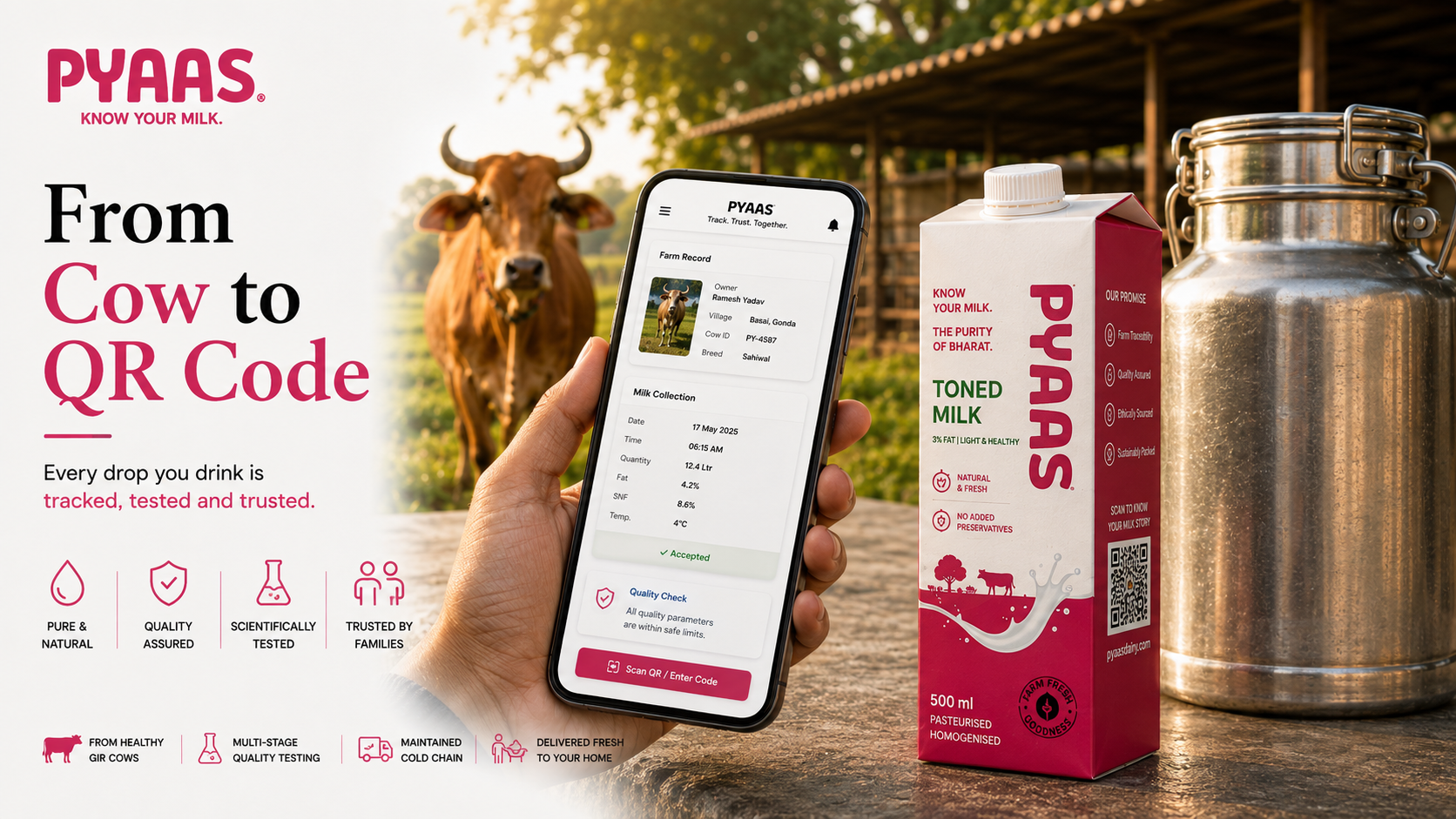
The Technology PYAAS Is Building for Parag: QR Traceability and a Modern Dairy Platform
18 August 2026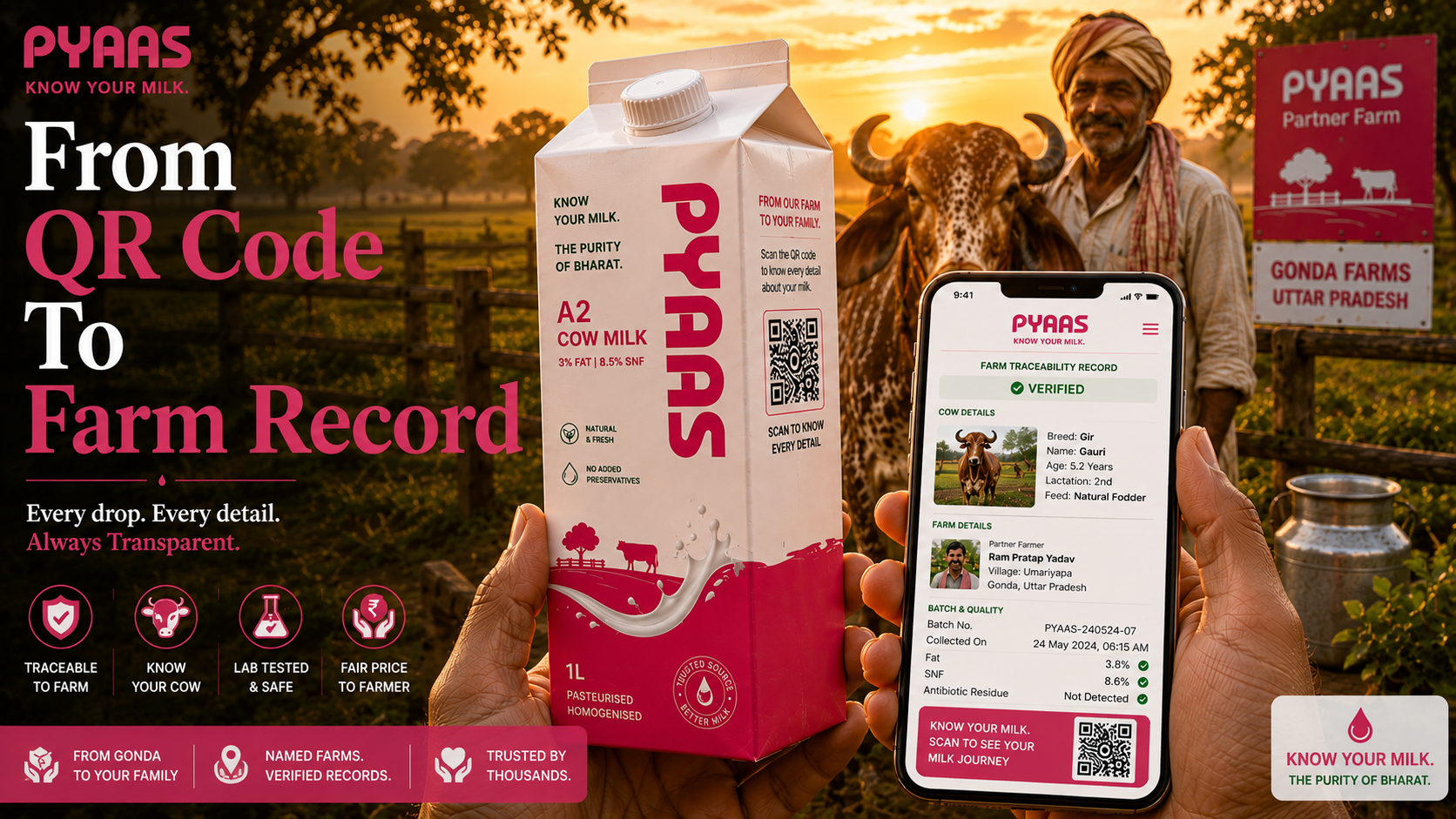
Why a Dairy Brand Needs a CTO: Aryan Sharma on Building PYAAS With Kushagra Kaushik
31 July 2026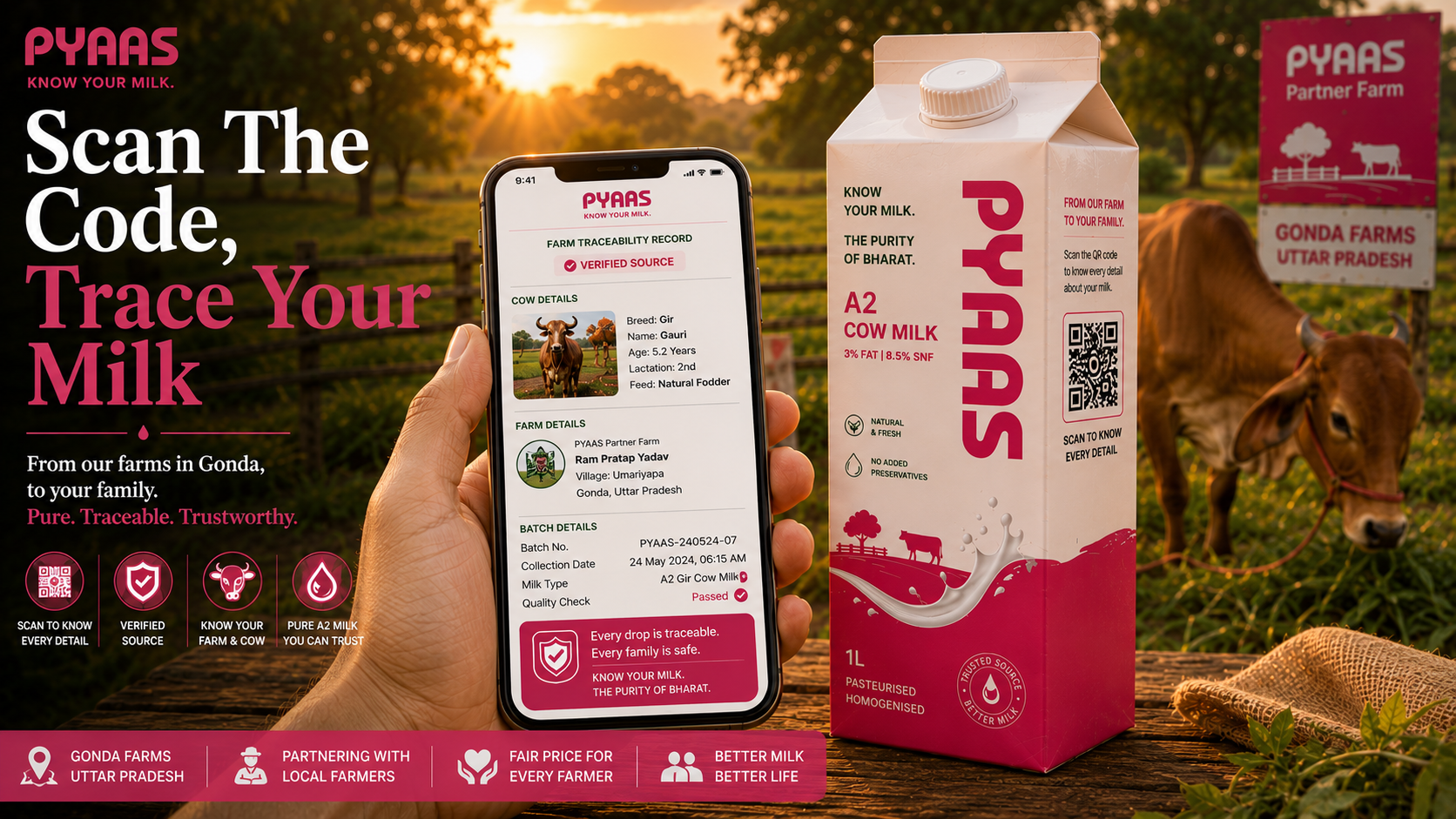
Why We Built PYAAS's Traceability Technology
29 July 2026