From QR Code to Farm Record: The Full Trace
Pick up almost any packet of milk and it asks one thing of you: trust. Trust that it came from where the label says, that it was handled with care, that it is what the pack claims. As the Founder and CTO of PYAAS, I did not want to ask you for that trust. I wanted to hand you the evidence. So the first thing I built was not an app or a website. It was the trace, a way to follow a single pack all the way back to the farm, the farmer and the exact batch it belongs to.
This is the honest, end-to-end version of how PYAAS milk traceability works, farm to pack, and what actually happens in the moment you scan the QR code.
The trust gap I set out to close
Most milk in India is pooled. It is collected from thousands of farms, mixed in large tanks, and by the time it reaches you the idea of a source has quietly disappeared. There is nothing left to trace back to, because there is no single origin to find. I understand why the industry works this way. It is efficient. But it also means a word like pure or natural on a carton is a claim you can never check.
At PYAAS our tagline is Know Your Milk, and I take the word know literally. Knowing is not being told. Knowing is being able to verify. So the design goal for the traceability system was simple to say and hard to build: every pack should carry proof of its own history that you can open in a few seconds.
What one scan shows you
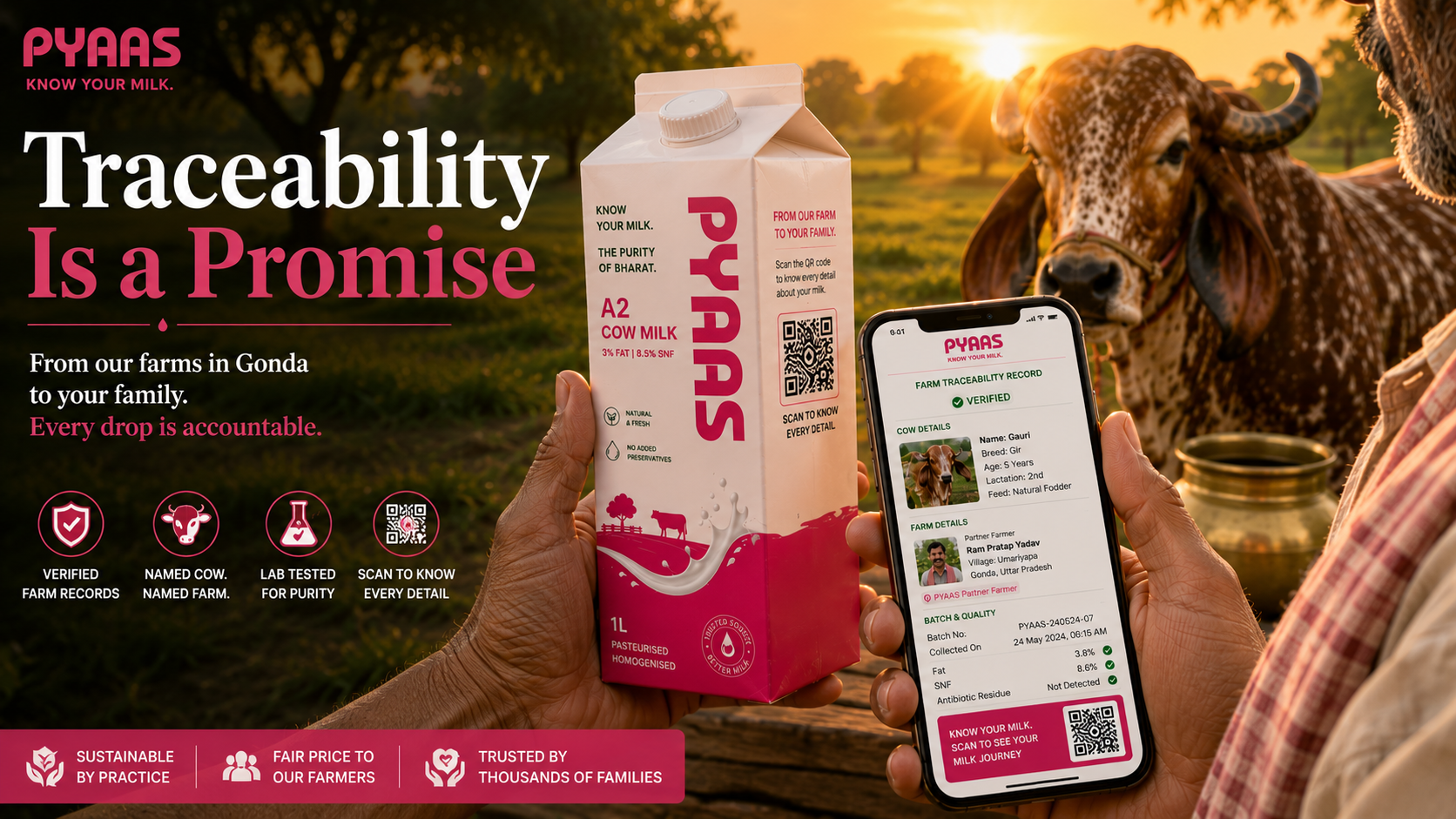
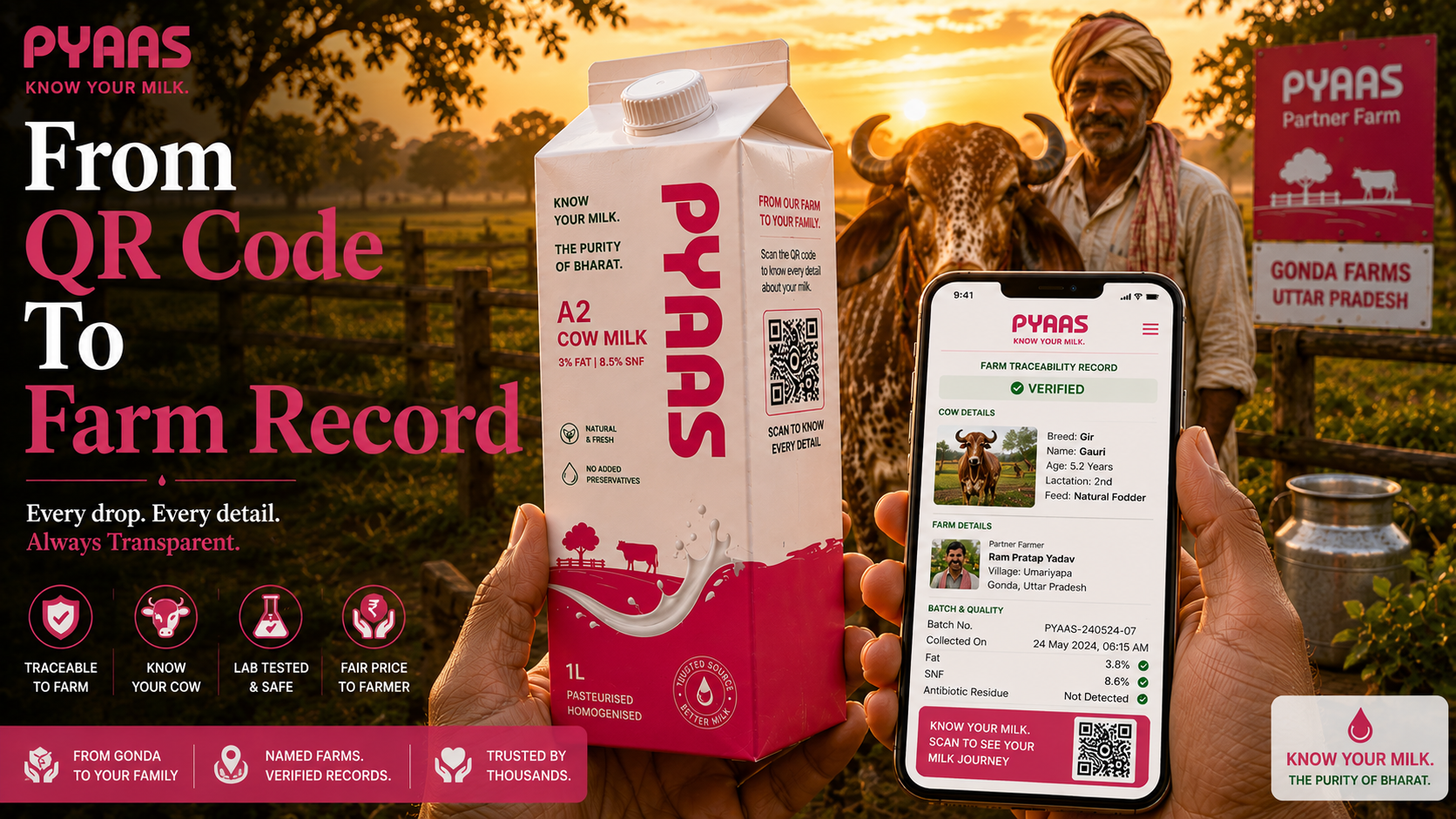
Every PYAAS pack carries a QR code. Point your phone at it and, instead of a marketing page, you get that specific pack's record:
- The farm. The named farm the milk came from, in Gonda, Uttar Pradesh, with its herd and its location.
- The farmer. The person who actually tends those cows, by name, not an anonymous supplier code.
- The batch record. When the milk left the farm and that batch's quality check, including its SNF and FAT readings.
No two packs have to tell the same story. The record is tied to the batch, so what you read is true for the milk in your hand, not a general statement about the brand.
The full trace, farm to pack
Behind that one scan is a chain I map end to end. Here is the journey a pack takes, and where the record picks up each fact along the way.
- 1. The farm. Milk starts at a named farm we work with directly, such as Sri Radha Mohan Dairy Farm, a herd of 76 Holstein Friesian and Sahiwal cows tended by the farmer Ram. The A2 milk comes from the A2 cows in that herd. From the very first step the origin has a name attached, not just a region.
- 2. Collection. The milk is collected and logged against that farm and that day, so the link between the farm and the batch is recorded before anything is mixed.
- 3. The quality check. Each batch is quality checked, and the readings that matter for milk, its SNF and FAT, are recorded against the batch rather than kept out of sight.
- 4. Batching. The batch is given an identity that stays with it. This is the pivot of the whole system: everything upstream, the farm, the farmer, the date, the quality check, is attached to that one batch identity.
- 5. The pack and its QR. When the product is packed, the QR code printed on it points back to that batch identity. Scanning it simply reads the record we already built, farm to pack, and shows it to you.
The reason I insist on this order is that traceability is only as honest as its weakest link. If the source is lost at collection, no clever software can invent it back later. So the trace is built forward, at each real step, and the QR code is just the door you open at the end.
Why single-origin keeps the trace honest
None of this works if milk is pooled. The moment you mix one farm's milk with a hundred others, farm to pack traceability becomes impossible, because there is no single farm left to name. That is the real reason PYAAS keeps milk single-origin from a small set of named farms in Gonda: Sri Radha Mohan Dairy Farm, Gonard Dairy, tended by Harsh Singh, and Ranjeet Singh Dairy Farm, tended by Ranjeet Singh. Fewer farms, each one known, is what makes the promise checkable instead of merely printed. You can meet them on our farms page, and see a full example on the sample traceability report. The wider idea sits on our Know Your Milk page.
Today this system is already live on our A2 Bilona ghee, which ships across India, so the trace is not a future promise. It is running now. Fresh A2 cow milk is next: PYAAS milk will launch in Lucknow from August 2026 and expand across Uttar Pradesh, and every one of those packs will carry the same QR code and the same farm-to-pack record from the very first day.
I am Kushagra Shekhar Kaushik, and I would rather build a slower brand you can verify than a bigger one you have to believe. The QR code is a small thing to look at and a hard thing to earn behind. Scan it, and hold us to exactly what it says. That, to me, is what Know Your Milk should always mean.
Written by
Kushagra Shekhar Kaushik
Kushagra Shekhar Kaushik is the Founder & CTO of PYAAS, an independent, transparency-first dairy brand based in Uttar Pradesh, building the technology that makes every pack traceable to its farm by QR.
More from Kushagra Shekhar KaushikCommon questions.
How does PYAAS milk traceability work?
Every PYAAS pack carries a QR code linked to its batch. Scan it and you can see the named farm the milk came from, the farmer who tends the herd, when the milk left the farm and that batch's quality check, including its SNF and FAT readings. The record is built forward at each real step, farm to pack, so it belongs to the exact milk in your hand and not a generic brand page.
What information is on the QR code on a PYAAS pack?
The named farm in Gonda, Uttar Pradesh and its herd, the farmer by name, the batch and the date the milk left the farm, and the batch's quality readings such as SNF and FAT. It is the history of that one pack, tied to its batch, so no two packs have to tell the same story.
Is PYAAS milk available now?
PYAAS A2 Bilona ghee ships across India today and already carries the QR traceability, so the trace is live now, not a future promise. Fresh A2 cow milk is launching in Lucknow from August 2026 and expanding across Uttar Pradesh, and every milk pack will carry the same farm-to-pack record from day one.
Get the next one in your inbox.
The occasional note on milk, ghee, and how we work. Plain words, no hype, and you can leave any time.
Keep reading.
What a Batch Code on Your Dairy Pack Means
2 September 2026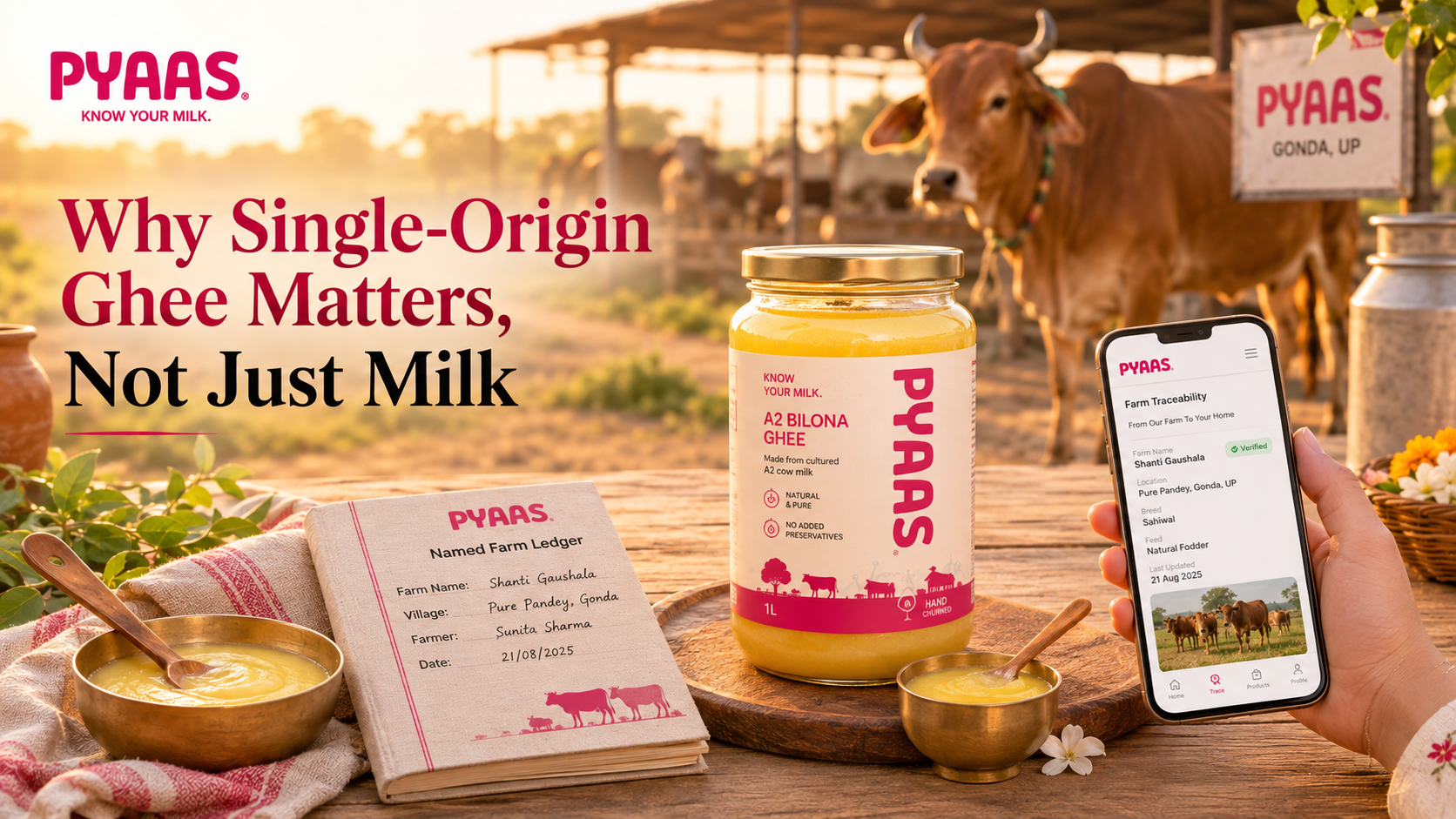
Why Single-Origin Ghee Matters, Not Just Milk
23 August 2026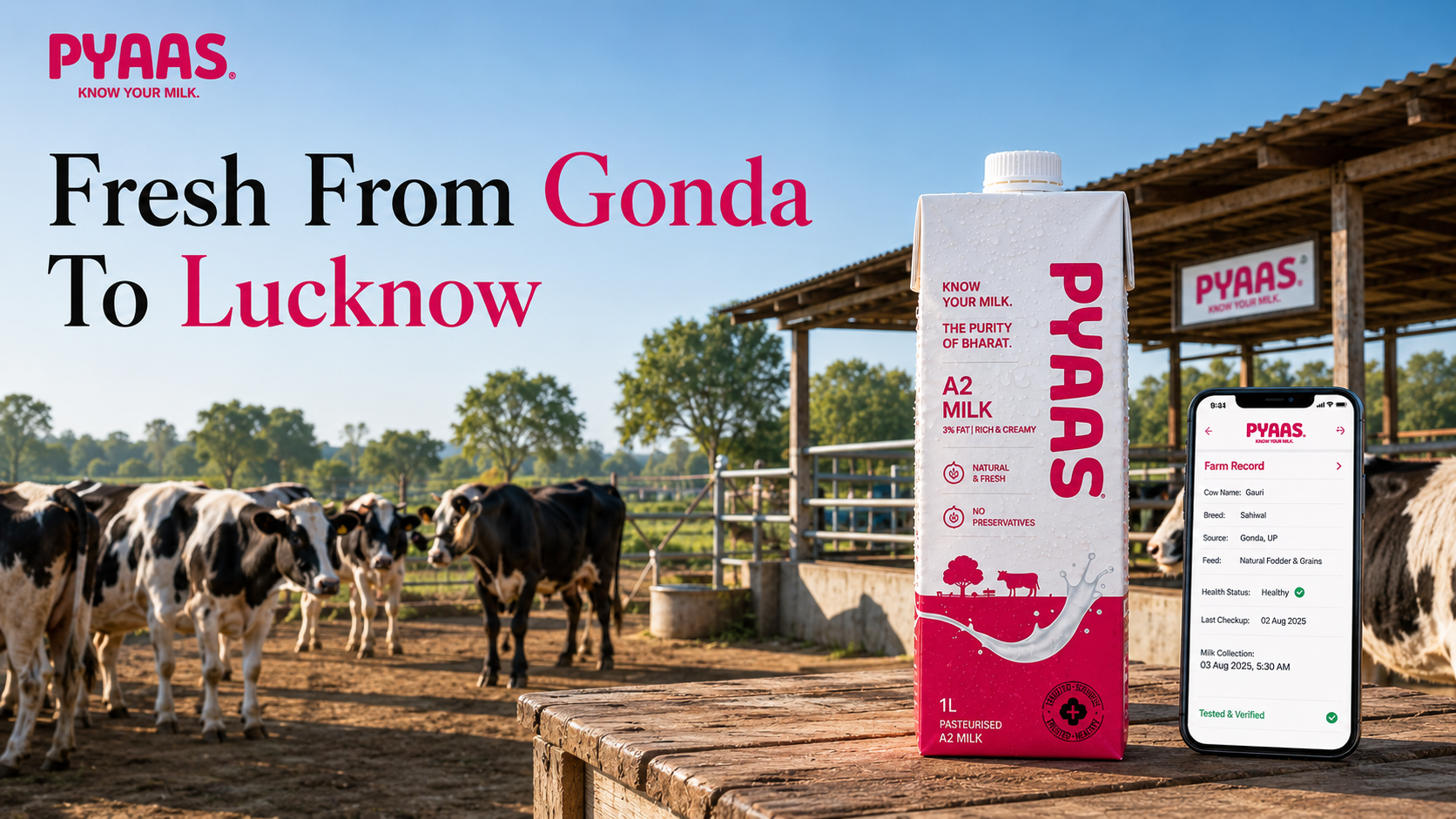
How PYAAS Keeps Milk Fresh From Gonda to Lucknow
21 August 2026
Traceability Is How PYAAS Earns Trust at Scale
28 July 2026