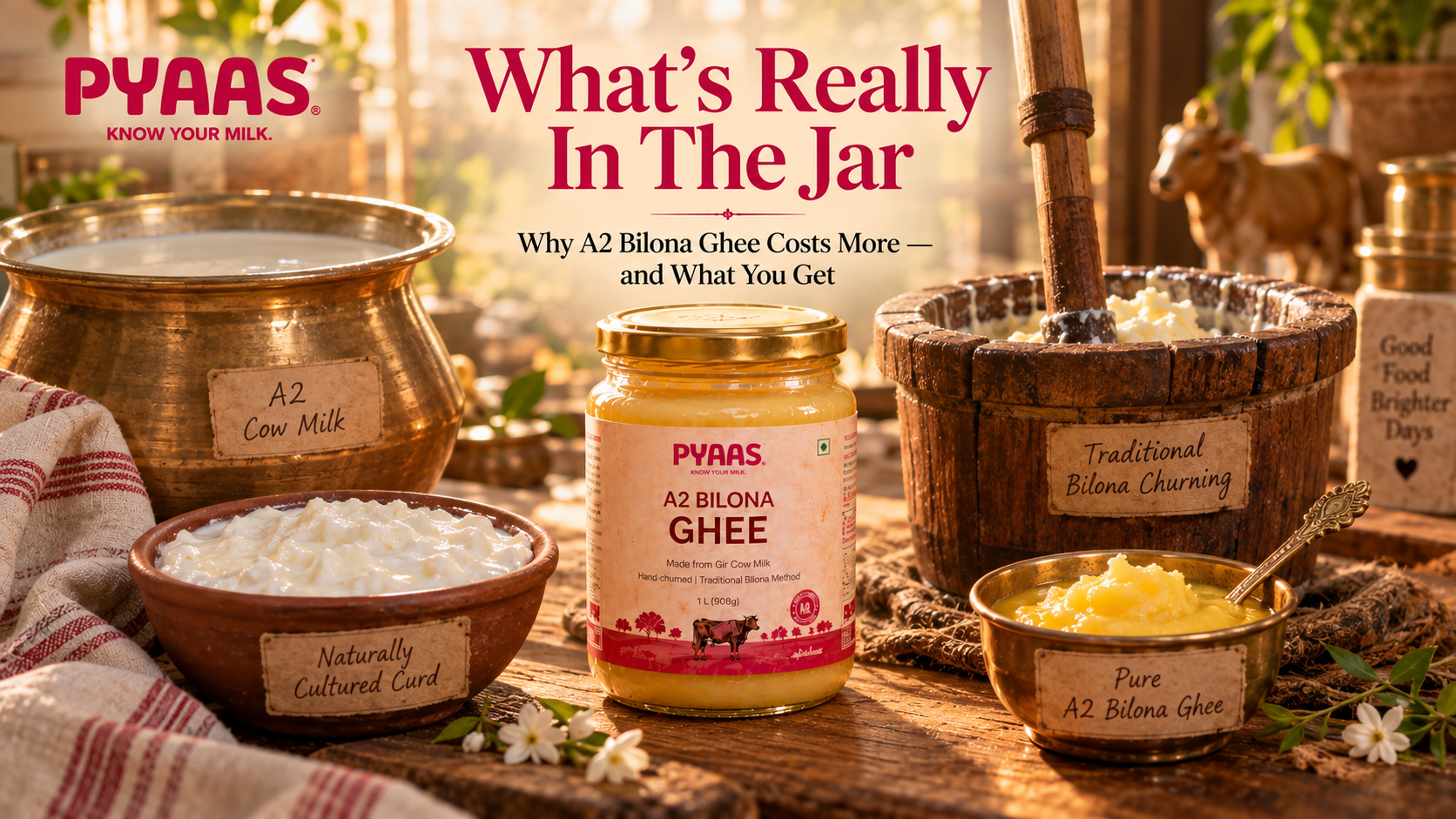
Why A2 Bilona Ghee Costs More — and What You Get
Stand in front of the ghee shelf and the question almost asks itself. There is a big economical tin at one price, and a smaller jar of A2 Bilona ghee at a noticeably higher one. Any careful shopper deserves a straight answer to the obvious question: why A2 Bilona ghee costs more. Not a marketing answer, not a guilt trip — a plain breakdown of what actually goes into that jar, so you can decide for yourself whether it earns its place in your kitchen. At PYAAS, honesty is the whole brand, so here it is, without the spin.
Reason one: it takes a lot of milk to make a little ghee
This is the biggest and least glamorous reason. Ghee is concentrated milk fat. Most of what is in milk — water, protein, sugar, solids — is separated out and removed along the way, leaving only the pure golden fat behind. That means it takes a substantial quantity of good milk to produce a single jar of ghee. Before any labour or method even enters the picture, the raw material cost is simply high, because you are condensing a large amount of milk into a small amount of ghee. Any honest ghee reflects this; the milk-to-ghee ratio is physics, not marketing.
Reason two: the Bilona method is slow and hands-on
"Bilona" refers to the traditional way of making ghee, and it involves more steps than the industrial shortcut. Instead of extracting fat directly from cream and clarifying it quickly, the Bilona route goes the long way round:
- The milk is first cultured into curd.
- That curd is churned to separate out butter — the traditional bilona churning step.
- The butter is then simmered slowly into ghee and strained.
Each of those steps takes time, attention and skilled hands. The culturing adds a day. The churning is labour. The slow simmering cannot be rushed. Compared to a fast factory process, this is simply more work per jar — and that work has a cost. Many people believe the method also gives a richer aroma, which is why it has survived for generations. If you want the full comparison, our piece on Bilona ghee vs regular ghee lays out the differences honestly.
Reason three: careful A2 sourcing
The "A2" part adds another layer of care. A2 refers to a type of protein in the milk, and it is a per-animal genetic trait — it comes only from the specific A2 cows identified within a herd, cow by cow. It is never as simple as pointing at a breed or a tank and calling it A2. That identification and separation takes deliberate effort and partnership with farms that know their animals. PYAAS works with named partner farms in Gonda, Uttar Pradesh, sourcing from the A2 cows within their herds rather than owning cattle or making blanket claims. That careful, honest sourcing costs more than buying pooled, unidentified milk. You can read how we think about this in our guide to A2 milk.
Reason four: small batches and real traceability
Mass ghee is made in enormous volumes, which lowers cost per unit but loosens the connection to any single source. PYAAS A2 Bilona ghee is made in small batches, and every jar carries a QR code you can scan to see the exact farm, the farmer and that batch's quality-checked record. Building and maintaining that traceability — the record-keeping, the batch checks, the partnership with specific farms — is genuine work that a faceless commodity does not do. When you can trace your ghee back to farmer Ram's herd at a named farm, someone has done the work to make that possible.
So what are you actually paying for?
Putting it together, the higher price of A2 Bilona ghee is not a premium slapped on for image. It reflects, honestly:
- A large quantity of milk condensed into a small jar of pure fat.
- The extra, unhurried steps of the traditional Bilona method — culture, churn, simmer.
- The labour and skill of hands-on making rather than fast machinery.
- Careful, cow-by-cow A2 sourcing from named partner farms.
- Small-batch production and real, scannable traceability.
You are not paying for a shinier label. You are paying for a method and a supply chain that cost more to run because they are done the honest way. For a fuller look at what sits behind ghee pricing across the market, see A2 ghee price in India.
Is it worth it? That is your call
Here is where we stay honest rather than pushy. Whether A2 Bilona ghee is worth the higher price depends entirely on what you value. If you buy purely on lowest cost per kilo, a big tin will always win, and that is a fair choice. But if you care about a traditional method, careful A2 sourcing, and the genuine peace of mind of scanning a code to see exactly where your ghee came from, then the price starts to look less like a premium and more like the true cost of doing it right. Understanding why A2 Bilona ghee costs more is really about seeing everything that a cheaper jar quietly leaves out. PYAAS would rather show you all of it, and let you decide with your eyes open.
Written by
Naina Sharma
PYAAS is an honest, traceable Indian dairy brand from Gonda, Uttar Pradesh.
More from Naina SharmaCommon questions.
Why is A2 Bilona ghee so expensive compared to regular ghee?
A2 Bilona ghee costs more because it takes a large amount of milk to make a small amount of ghee, and the traditional Bilona method adds extra steps — culturing the milk into curd, churning it into butter, then simmering that into ghee. It also relies on carefully sourced A2 milk and far more hands-on labour. You are paying for the method and the sourcing, not a fancy label.
Is A2 Bilona ghee worth the higher price?
Whether it is worth it depends on what you value, but the higher price reflects real costs rather than markup for its own sake — more milk per jar, more time, more skilled labour and traceable A2 sourcing. If you care about a traditional method and knowing exactly where your ghee comes from, many families find that peace of mind worth it. It is a considered purchase, not a daily commodity.
How much milk does it take to make one kg of ghee?
It takes a substantial quantity of milk to make a single kilogram of ghee, because ghee is concentrated milk fat and most of the milk is water and solids that are removed along the way. This milk-to-ghee ratio is one of the main reasons why A2 Bilona ghee costs more than everyday cooking oils or blended ghee.
Get the next one in your inbox.
The occasional note on milk, ghee, and how we work. Plain words, no hype, and you can leave any time.
Keep reading.
What Is BCM-7 and Why It Matters in A2 Milk
18 August 2026
A2 Bilona Ghee in Gorakhpur: A Buyer's Guide
13 September 2026
A2 Bilona Ghee in Mathura and Vrindavan
13 September 2026
Buy A2 Bilona Ghee Online Anywhere in India
13 September 2026