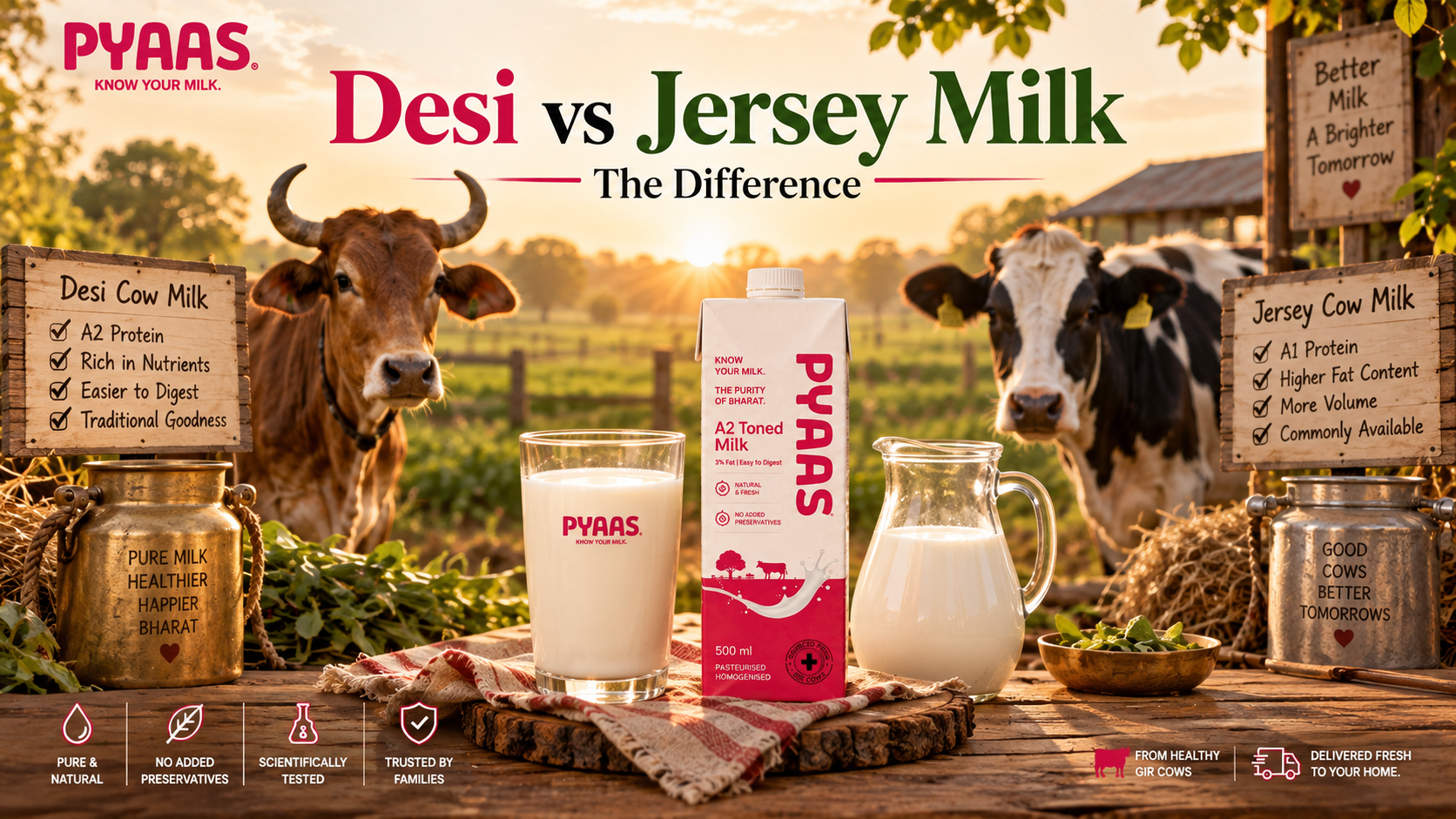
Desi Cow vs Jersey Cow Milk: The Difference
Walk through any conversation about milk in India and sooner or later someone will plant a flag: desi cows give the good stuff, or Jersey cows give more of it. The desi cow vs Jersey debate is passionate, often oversimplified, and full of half-truths. Let us sort it out honestly, because the real answer is more interesting, and more useful, than either side's slogan.
Two very different origins
Desi, or indigenous, cows are the native cattle of India, breeds like Sahiwal, Gir, Tharparkar and many more, shaped over centuries by Indian climate and conditions. Jersey cows, by contrast, are an exotic breed originally from the Channel Island of Jersey, brought into India and crossbred to raise milk production. From the start, the two were developed with different priorities.
What each is known for
Desi cattle are generally hardy, heat-tolerant and disease-resistant, and their milk is often described as rich and wholesome. They typically yield less milk per cow than high-production exotic breeds. Jersey cows are valued mainly for yield and efficiency; they produce more milk and adapt reasonably to managed dairy systems, which is why they and other exotics dominate commercial volume.
- Desi cows: hardy, richer milk, lower yield, stronger A2 tendency.
- Jersey cows: higher yield, developed for production, more A1 tendency.
- Both: give nutritious milk with calcium, protein and fat.
The A2 question, where most myths live
The heart of the modern debate is A2. Milk protein includes beta-casein, which comes in A1 and A2 forms differing by a single amino acid. Indigenous desi breeds tend to carry the A2 form more often, while exotic breeds like Jersey tend to carry more A1. This is the grain of truth that the whole desi-versus-Jersey argument is built on, and our piece on A1 versus A2 milk explains the protein difference in detail.
Here is where honesty has to replace slogans. A2 is a per-animal genetic trait. It is decided one cow at a time, not by breed label. A desi cow can carry A1. A Jersey cow can carry A2. Breed only tells you the odds, not the outcome. So statements like all desi milk is A2 or all Jersey milk is A1 are simply wrong, however often they are repeated. If you want a cow's milk to be A2, you have to check that individual animal, not trust the breed name on a poster.
It is also worth remembering that A2 milk, whatever breed it comes from, is not a cure for anything. Many people find it easier to digest, the science is still settling, and A2 does nothing about lactose, the milk sugar. The desi-versus-Jersey argument should be about tendencies and quality, not miracle claims.
So which should you choose?
If you value richer milk and a stronger chance of A2, indigenous breeds are appealing. If sheer availability and volume drive the market, Jersey and crossbred milk fill much of it. But the smartest question is not which breed, it is which source you can actually verify. A known farm that identifies its A2 cows honestly is worth more than a breed name used as a marketing badge.
Among indigenous options, the Sahiwal is one of India's finest dairy breeds, hardy and well regarded, and it carries the A2 tendency that makes desi cattle interesting in the first place.
How PYAAS handles it honestly
PYAAS does not pick a side in the slogan war; we respect the biology. Our partner herds in Gonda, Uttar Pradesh are Holstein Friesian and Sahiwal, so we work with both indigenous and exotic cattle. Rather than claim a whole herd or breed is A2, we identify the A2 cows within our herds cow by cow and keep their milk separate. That is the only truthful way to make an A2 claim.
And we let you check it. Every pack carries a QR code you scan to see the exact farm, farmer and that batch's quality-checked record, which is what turns an A2 label into something verifiable rather than a hopeful guess. Fresh A2 cow milk launches in Lucknow from August 2026 across Uttar Pradesh, while our A2 Bilona ghee ships across India today.
The honest takeaway
In the desi cow vs Jersey debate, both breeds give nourishing milk, desi cattle lean richer and more A2, Jersey cattle lean higher-yield and more A1, and none of that is absolute. The single most important truth is that A2 is decided cow by cow, not by breed. So choose the milk whose source you can actually see, from a brand willing to identify its A2 cows one at a time and let you scan the proof.
Written by
Naina Sharma
PYAAS is an honest, traceable Indian dairy brand from Gonda, Uttar Pradesh.
More from Naina SharmaCommon questions.
Is desi cow milk better than Jersey milk?
Better depends on what you value. Desi cow milk is prized for its richness and its greater tendency towards A2 beta-casein, while Jersey and other exotic breeds are known for higher yields. Neither is universally superior, and in the desi cow vs Jersey debate the honest answer is that they simply differ.
Do Jersey cows only give A1 milk?
Not necessarily. Exotic breeds like Jersey tend to carry the A1 form of beta-casein more often, but A2 is a per-animal genetic trait, so an individual Jersey cow can carry A2. Breed gives you a tendency, not a guarantee, which is why A2 must be checked cow by cow.
How does PYAAS decide which milk is A2?
PYAAS identifies the A2 cows within each partner herd individually, because whether a cow produces A1 or A2 is genetic and specific to that animal. Our herds are Holstein Friesian and Sahiwal, and we keep A2 milk separate rather than claiming any whole breed or herd is all A2.
Get the next one in your inbox.
The occasional note on milk, ghee, and how we work. Plain words, no hype, and you can leave any time.
Keep reading.
Why A2 Bilona Ghee Costs More — and What You Get
13 September 2026
A2 Bilona Ghee in Gorakhpur: A Buyer's Guide
13 September 2026
A2 Bilona Ghee in Mathura and Vrindavan
13 September 2026
Buy A2 Bilona Ghee Online Anywhere in India
13 September 2026