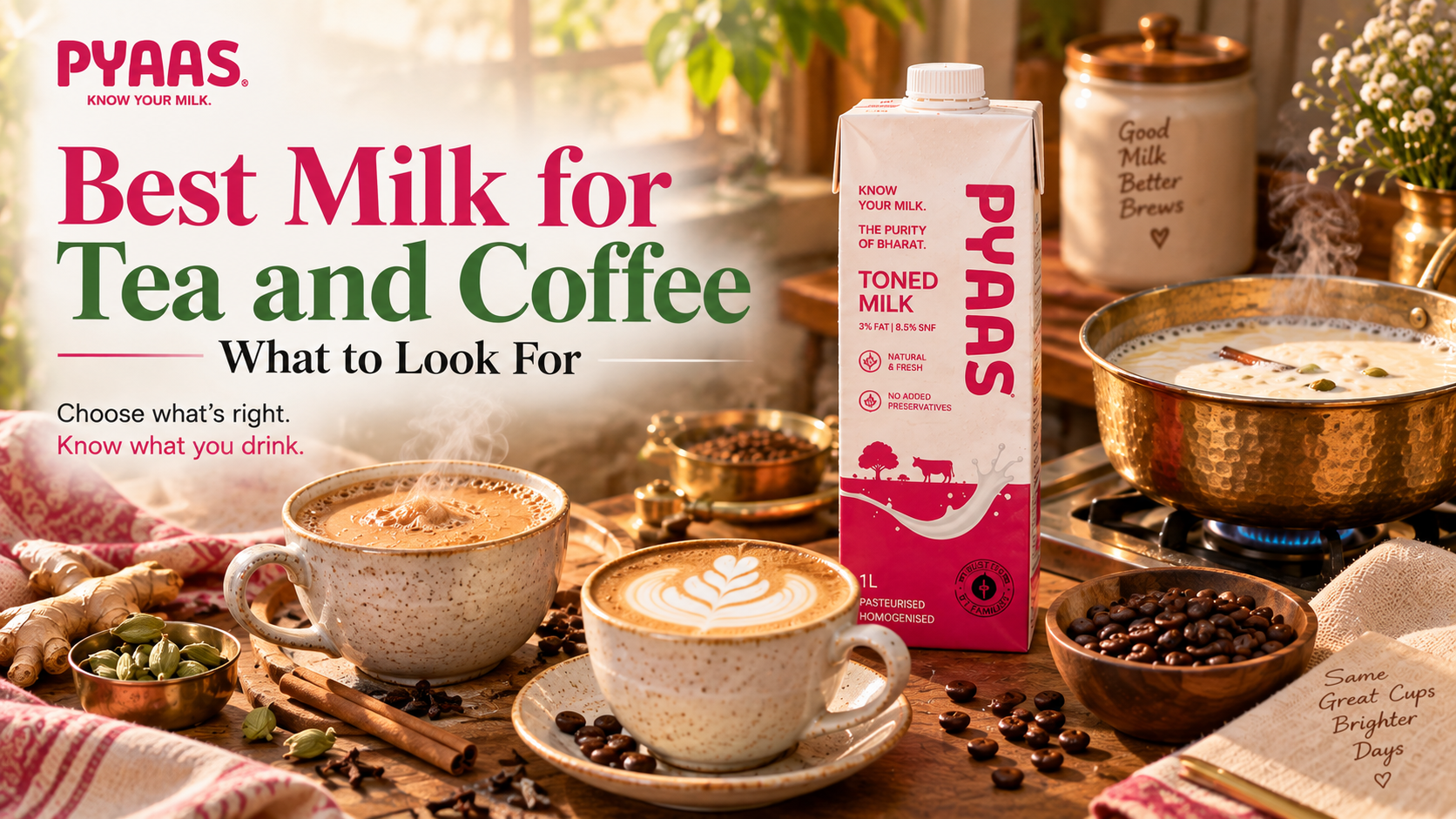
Best Milk for Tea and Coffee: What to Look For
Most of us drink milk more often in a cup than in a glass. That morning chai or the evening coffee is, for millions of Indian households, the single biggest use of milk in the day. And yet we rarely stop to ask which milk actually makes the best cup. If you have ever wondered what the best milk for tea and coffee really is, this is an honest walk through what matters, and what is just marketing.
Three things that actually change your cup
When it comes to tea and coffee, three properties of milk do most of the work: fat, freshness and froth. Get these right and almost any decent tea or coffee tastes better.
Fat: body and mouthfeel
Fat is what gives milk its richness. In a strong Indian chai boiled with ginger and cardamom, full-cream milk stands up to the spices and delivers that satisfying, rounded mouthfeel. Toned and skimmed milks make a thinner, more watery cup because there is simply less fat to carry flavour. For coffee, fat softens bitterness and adds a creamy finish. If you want to understand where that fat and richness comes from, our guide to milk nutrition facts lays it out plainly.
Freshness: the quiet dealbreaker
Freshness rarely gets talked about, but it is often the difference between a smooth cup and a split, curdled mess. As milk ages it becomes slightly more acidic, and acidic milk is far more likely to curdle when it hits hot tea or acidic coffee. Genuinely fresh milk, stored cold, behaves predictably: it boils cleanly, foams better and tastes sweeter. This is one reason the source and supply chain of your milk matters more than the label's claims.
Froth: it's mostly about protein
There is a common myth that froth comes from fat. In truth, milk protein is what stabilises foam, while fat makes that foam taste rich. Fresh full-cream milk gives you both: enough protein to hold a foam and enough fat to make a cappuccino feel indulgent. Cold, fresh milk also steams into a finer microfoam, which is why baristas are fussy about how their milk is stored.
A quick honest guide to milk types
- Full-cream fresh cow milk: The all-rounder. Best body for chai, good froth for coffee, naturally sweet.
- Toned / double-toned milk: Lighter and lower in fat. Fine for everyday tea if you prefer less richness, but a thinner cup.
- Long-life / UHT milk: Convenient and shelf-stable, but the high-heat processing can leave a faintly cooked note some people notice in delicate coffee.
- A2 cow milk: Distinguished by its protein type, not its fat. Many people find A2 milk easier to digest, though the science is still settling. It is not a fix for lactose intolerance, since that involves lactose, a sugar, not the A2 protein.
The ghee-chai note, honestly
You may have seen the trend of stirring a small spoon of ghee into black coffee or chai for a richer, longer-lasting cup. It is a real thing some people enjoy, and a good ghee melts into a silky sheen on top. We would frame it honestly: it is a taste-and-ritual choice, not a health prescription, and a little goes a long way. If you are curious about what makes a clean, aromatic ghee, our complete guide to PYAAS A2 Bilona ghee explains how it is made.
What to look for when you buy
- Fat level suited to your cup: Full-cream for rich chai and coffee, toned if you want it lighter.
- Genuine freshness: Not just a printed date, but a supply chain short enough that the milk reaches you soon after milking.
- Traceability: Can you tell where the milk actually came from? A brand that can name the farm has less to hide.
- Cold storage: Milk that has stayed properly cold behaves better in the cup and lasts longer.
The honest bottom line
The best milk for tea and coffee is usually the freshest full-cream cow milk you can get, from a source you actually trust. Fat gives body, freshness prevents curdling and rewards you with a sweeter taste, and protein does the frothing. Everything else is preference.
At PYAAS, our answer to trust is simple: know your milk. Our fresh A2 cow milk launches in Lucknow from August 2026 and will expand across Uttar Pradesh, and every pack carries a QR code linking to the exact farm, the farmer, and that batch's quality record, so you know precisely what is going into your morning cup. For everyone across India, our A2 Bilona ghee ships today if you want to try that spoon in your chai. If you would like to see what is coming and where, take a look at where to buy PYAAS A2 milk and ghee. A better cup really can start with better, more honest milk.
Written by
Naina Sharma
PYAAS is an honest, traceable Indian dairy brand from Gonda, Uttar Pradesh.
More from Naina SharmaCommon questions.
What is the best milk for tea?
For a rich, traditional Indian chai, full-cream fresh cow milk is usually the best milk for tea because its natural fat gives body and a smooth mouthfeel that stands up to strong tea and spices. Toned or skimmed milk makes a thinner cup. Freshness matters too, as very old or near-expiry milk can split when boiled with tea.
Does higher fat milk froth better for coffee?
Fat adds richness and a creamy mouthfeel, but froth stability actually comes largely from milk protein. Fresh full-cream milk gives a good balance of both: enough protein to hold a foam and enough fat to make it taste luxurious. For latte art, cold, fresh, well-stored milk steams into a finer microfoam.
Why does my milk curdle in tea or coffee?
Milk usually curdles when it is old and slightly acidic, or when it meets very hot, acidic coffee. Fresh milk that has been stored cold is far less likely to split. If you regularly get curdling, check the freshness of your milk and avoid pouring cold milk straight into extremely hot, acidic brews.
Get the next one in your inbox.
The occasional note on milk, ghee, and how we work. Plain words, no hype, and you can leave any time.