A2 Ghee vs Regular Market Ghee: The Real Difference
Walk down any grocery aisle and you'll see a wall of ghee that all looks roughly the same: golden, glossy, promising tradition and purity in identical fonts. Then you notice the prices, which swing wildly, and you're left holding two tins wondering what on earth actually separates them. The honest answer to A2 ghee vs regular ghee has very little to do with the colour in the jar and almost everything to do with two questions: where did the milk come from, and how was the ghee made?
Let's take those apart plainly, without pretending one is a miracle and the other is poison.
It starts with the milk, not the ghee
Ghee is only ever as good as the milk behind it. That's the part most labels skip.
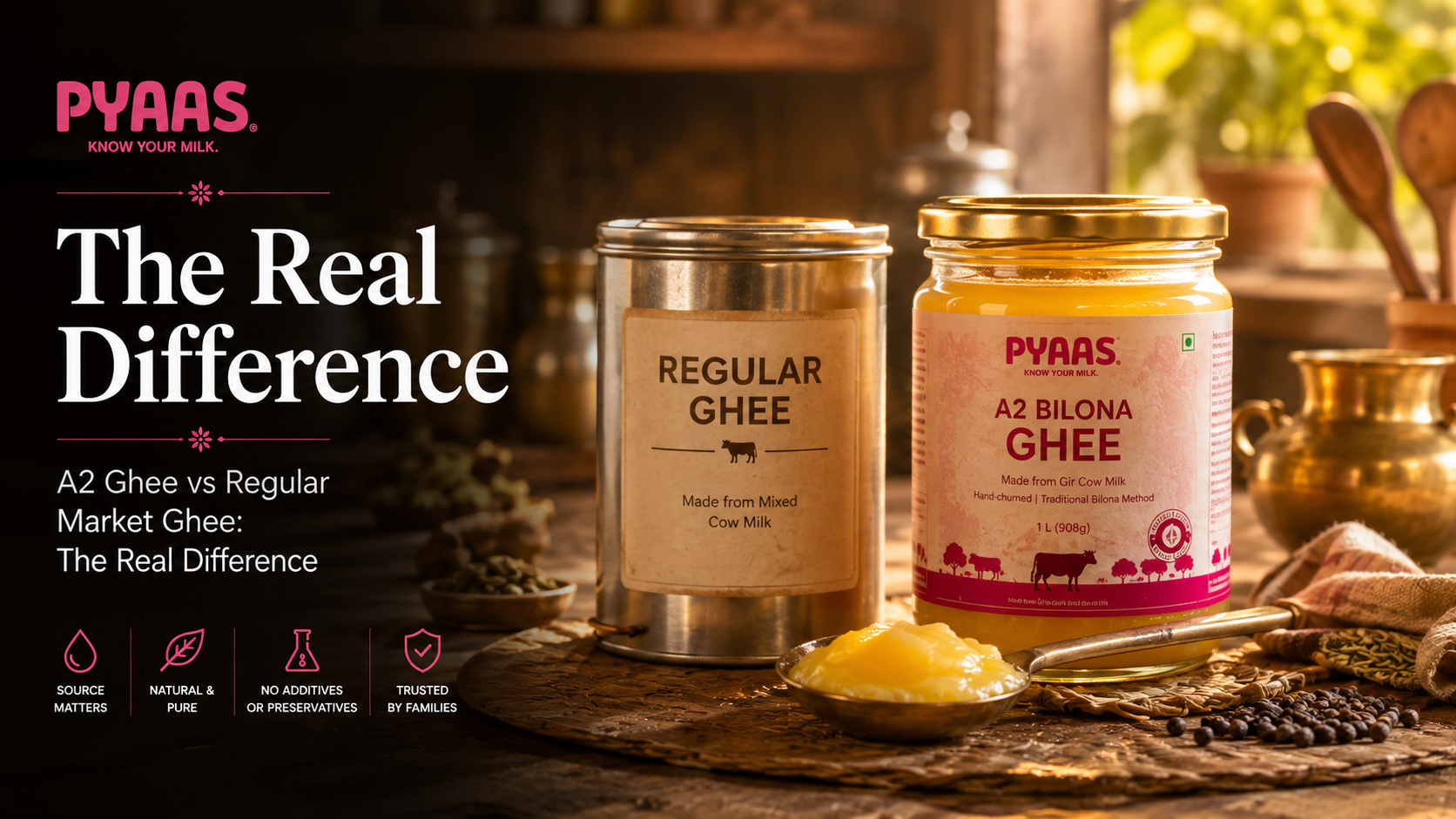
Regular market ghee is typically made from milk pooled together at large scale, often from many sources you'll never see named. The milk gets blended into one big stream, turned into butter or cream, and clarified into ghee in volume. There's nothing sinister about scale by itself. The problem is that once milk from countless animals and farms is mixed into one tank, the connection between the ghee and any real cow, farm or day is simply gone. You're trusting a brand name, not a source.
A2 ghee starts from a narrower, more deliberate place. A2 refers to a type of beta-casein protein in milk, and it's a per-animal genetic trait. It comes only from the specific A2 cows within a herd, identified cow by cow. This matters for honesty: a whole herd or breed is never simply "all A2", because it depends on the individual animal's genetics. At PYAAS our partner herds include Holstein Friesian and Sahiwal cattle, and the A2 milk is drawn from the A2 animals within those herds. If you want the deeper science, we've laid it out in our guide to what A2 milk really is.
The method: bilona vs bulk
The second real difference in A2 ghee vs regular ghee is how the ghee is made.
The traditional bilona method is slower and more hands-on. In simple terms, milk is cultured into curd, the curd is churned to draw out butter, and that butter is simmered gently into ghee. It's a longer road with more steps, and it's the way ghee was made in Indian kitchens for generations. Large-scale industrial ghee usually skips the curd stage and clarifies cream or butter directly at volume, which is faster and cheaper but a genuinely different process.
Is bilona automatically "better"? It's more careful and more traditional, and many people prefer the aroma and character it gives. But the more useful point is honesty: knowing which method made your ghee tells you what you actually bought. We break the two apart in detail in bilona ghee vs regular ghee, and if you're curious how the whole thing works, how ghee is made from fresh milk to golden ghee walks through every stage.
Traceability: the difference you can actually check
Here's where the comparison stops being abstract. With most regular market ghee, you cannot answer a simple question: which farm did this come from? The information doesn't exist for you to check. With truly traceable A2 ghee, it does.
Every PYAAS A2 Bilona ghee pack carries a QR code. Scan it and you see the exact farm, the farmer, and that batch's quality-checked record. It ties the jar in your hand to a real place and real people, so "pure" stops being a word on a label and becomes something you can look up. That's the whole idea behind our Know Your Milk promise: not asking you to trust us, but giving you a way to verify.
What actually differs, side by side
- Source: A2 ghee comes from A2 cows identified individually; regular ghee usually comes from pooled, unnamed milk.
- Method: Good A2 ghee is often made the traditional bilona way; most bulk ghee is clarified at industrial scale.
- Traceability: Traceable A2 ghee like PYAAS lets you scan a QR to see the farm and batch; regular ghee typically offers no such trail.
- Scale and batch: A2 bilona ghee is often made in small batches; commodity ghee is made in large continuous runs.
Let's be honest about health
I'm not going to tell you A2 ghee is a health cure, because it isn't, and neither is any ghee. Nutritionally, ghee is ghee in broad strokes. What changes with A2 and bilona is the story of source and method, not a magic property.
One genuinely useful fact for everyone: ghee is clarified butter with most milk solids removed, which makes it very low in lactose and casein. Many, though not all, lactose-intolerant people tolerate ghee well for that reason. That's true of good ghee generally, A2 or not. If you have real dairy sensitivities or health conditions, introduce any new food gently and talk to your doctor rather than a label.
So which should you buy?
If all you want is fat to cook with and price is the only thing you care about, regular market ghee will do the job. If you want to actually know what you're eating, where the milk came from, how the ghee was made, and be able to check it, that's the case for traceable A2 ghee.
That's the honest heart of A2 ghee vs regular ghee. It isn't a battle of good versus bad. It's a choice between an anonymous golden tin and a jar that can tell you its own story. PYAAS A2 Bilona ghee is our attempt at the second kind, and it's live and shipping across India today, with a QR code that's happy to be scanned. We'd rather earn your trust by being checkable than by shouting the loudest.
Written by
Naina Sharma
PYAAS is an honest, traceable Indian dairy brand from Gonda, Uttar Pradesh.
More from Naina SharmaCommon questions.
What is the main difference between A2 ghee and regular market ghee?
In a2 ghee vs regular ghee, the difference is mostly about source and method. A2 ghee is made from milk drawn from A2 cows, identified animal by animal, and good A2 ghee is often made by the traditional bilona method. Regular market ghee is usually made from mixed, untraceable milk at large scale, so you rarely know where it came from.
Is A2 ghee healthier than regular ghee?
Ghee is ghee nutritionally in broad terms, and no ghee is a health cure. What A2 ghee offers is a clearer story about source and how it was made, which many people value. If you have specific health concerns, it's best to speak with a doctor rather than rely on any ghee's marketing.
Can lactose-intolerant people eat A2 ghee?
Ghee is clarified butter with most milk solids removed, so it is very low in lactose and casein, and many lactose-intolerant people tolerate it well. This is true of good ghee generally, not only A2. If you react strongly to dairy, introduce it cautiously and check with your doctor.
Get the next one in your inbox.
The occasional note on milk, ghee, and how we work. Plain words, no hype, and you can leave any time.