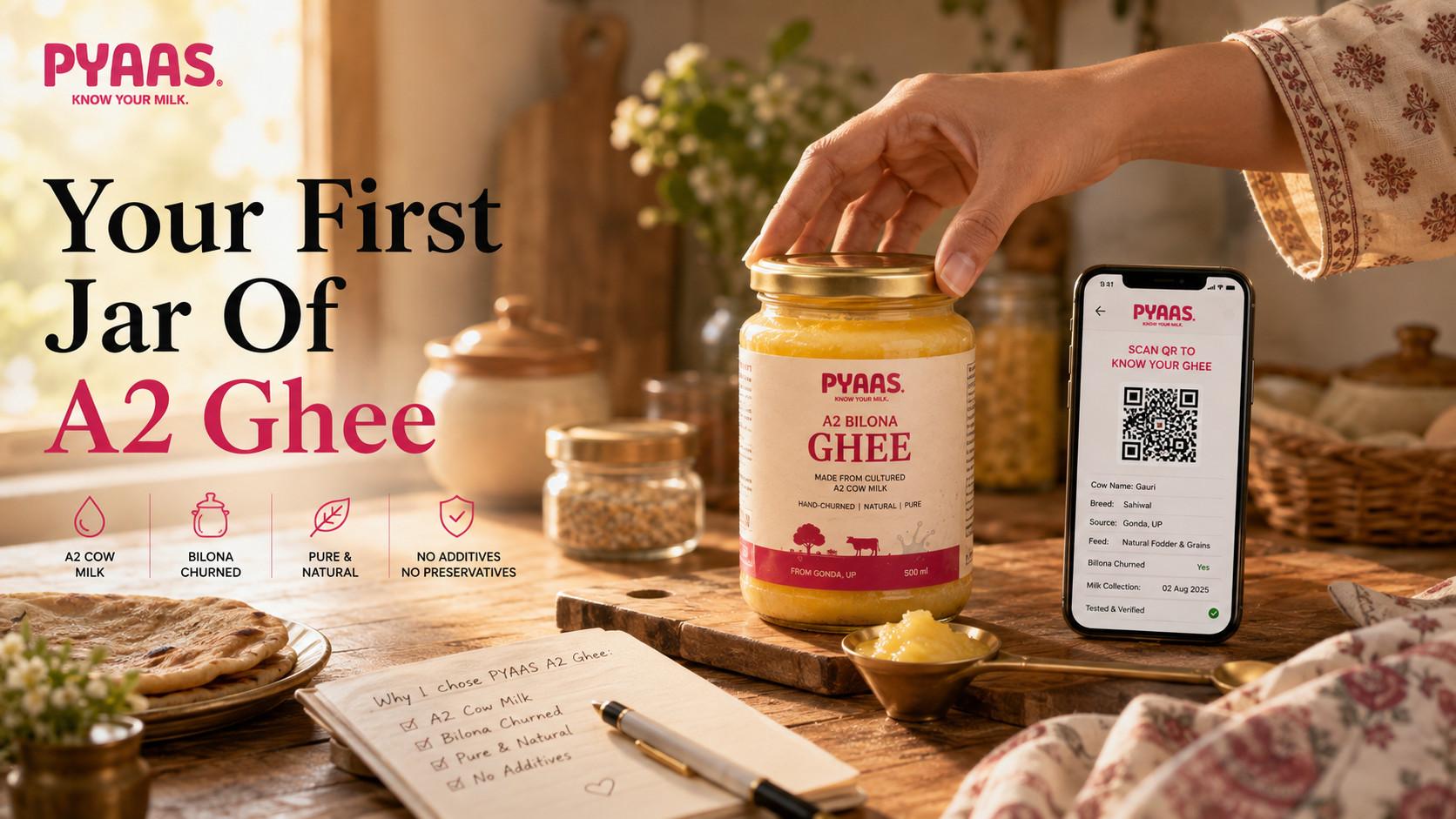
A Beginner's Guide to Buying Your First A2 Ghee
You've heard friends rave about A2 ghee. You've seen the golden jars with their earnest labels. And now you're standing in front of a shelf, or a checkout page, feeling slightly foolish because every single one claims to be the purest and most traditional, and you have no idea how to tell them apart. If that's you, breathe. Choosing your first jar is much simpler than the marketing makes it feel, and this buying A2 ghee guide will give you a short checklist you can actually use.
No jargon, no fear, no promises that ghee will transform your life. Just the four things worth checking before you spend.
First, what A2 ghee even is
Quick and honest: A2 refers to a type of beta-casein protein found in milk. It's a per-animal genetic trait, which means A2 milk comes only from the specific A2 cows within a herd, identified cow by cow. That's an important truth to hold onto, because a whole herd or breed is never automatically "all A2". A2 ghee is simply ghee made from that A2 milk. Many people find A2 dairy easier to digest, though the science is still settling and it's not a cure for anything, including lactose intolerance. If you want the fuller picture first, our guide to A2 ghee benefits lays it out plainly.
The four things worth checking
Here's the whole buying A2 ghee guide in one list. If a jar passes these four, you can buy with confidence.
- Source: Can they name where the milk comes from? Vague words like "farm-fresh" mean nothing. A named farm or region is a good sign; total silence about origin is a quiet red flag.
- Method: Is it made the traditional bilona way, where milk is cultured into curd, churned to butter, and simmered into ghee? Or is it clarified at industrial scale? Neither is evil, but you deserve to know which you're paying for.
- Traceability: Is there a QR code or some way to actually check the source? A brand willing to be verified is a brand with less to hide.
- Freshness and batch size: Small batches generally mean more care and fresher stock than enormous continuous runs. Ask how it's made and how it's stored.
That's it. Source, method, traceability, freshness. Memorise those four words and you'll never feel lost in front of a shelf again.
Don't be fooled by colour, aroma or price
Beginners often judge ghee by how it looks. Resist that. Colour depends on the cattle's feed and the method, and it tells you almost nothing about quality or honesty. Aroma is lovely but can be influenced by processing. And price cuts both ways: expensive doesn't guarantee good, and cheap doesn't guarantee bad. The label's confidence is not evidence. Only the four checks above are.
Why good A2 ghee costs more, honestly
Let's talk money, because it's the question everyone's too polite to ask. A2 ghee usually costs more than a basic tin, and it's fair to want to know why. The honest reasons: sourcing is narrower because you're drawing from A2 cows specifically, the traditional bilona method is slower and more labour-intensive, small batches cost more per jar than giant runs, and keeping everything traceable is real work. You're paying for source and method, not for a secret miracle ingredient. We break down exactly what sits behind the number in A2 ghee price in India: what you're paying for. Whether it's worth it is genuinely your call, and it depends on how much origin matters to you.
A note on health, without the hype
I won't pretend ghee is medicine. No ghee cures, treats or prevents disease, and anyone telling you otherwise is selling, not informing. One genuinely useful fact, though: because ghee is clarified butter with most milk solids removed, it's very low in lactose and casein, and many (not all) lactose-intolerant people tolerate it well. That's true of good ghee generally, A2 or not. Start with a small amount, see how you feel, and if you have real dairy sensitivities or health conditions, talk to your doctor rather than a jar's label.
How PYAAS fits your checklist
Since I've handed you a checklist, it's only fair to show our own work against it. PYAAS A2 Bilona ghee is:
- Sourced from named partner farms in Gonda, Uttar Pradesh, drawing on the A2 cows within herds that include Holstein Friesian and Sahiwal cattle.
- Made the traditional bilona way, in small batches.
- Traceable: every pack carries a QR code you scan to see the exact farm, the farmer, and that batch's quality-checked record.
That last point is the one we care about most. It's the difference between us telling you it's honest and you being able to check. If you'd like to see the whole philosophy, Know Your Milk is where it starts. And happily for a first-timer anywhere in the country, our ghee is live and ships across India today, so you don't have to wait to try it.
Your first jar, chosen with confidence
Buying your first A2 ghee shouldn't feel like a test you might fail. Ignore the shouting labels, forget the colour, and run every jar past four simple questions: where's it from, how's it made, can I check it, and is it fresh? That's the entire buying A2 ghee guide, and it puts you back in charge of the decision. When a brand can answer all four out loud, and hand you a QR code to prove it, you've found ghee worth bringing home. That's exactly the standard we built PYAAS to meet, and the one we'd like you to hold us to.
Written by
Naina Sharma
PYAAS is an honest, traceable Indian dairy brand from Gonda, Uttar Pradesh.
More from Naina SharmaCommon questions.
How do I choose good A2 ghee as a beginner?
The simplest buying a2 ghee guide is to check four things: the source (can they name the farm?), the making method (is it traditional bilona?), traceability (is there a QR code you can scan?), and freshness (small batches over huge anonymous runs). If a brand can answer all four honestly, you're in good hands.
Why is A2 ghee more expensive than regular ghee?
A2 ghee usually costs more because of narrower sourcing from A2 cows, the slower traditional bilona method, small-batch making, and the work of keeping it traceable. You're paying for source and method, not a magic ingredient. Whether it's worth it depends on how much knowing your ghee's origin matters to you.
Is A2 ghee safe for people who are lactose intolerant?
Ghee is clarified butter with most milk solids removed, so it is very low in lactose and casein, and many lactose-intolerant people tolerate it well. This is true of good ghee generally, A2 or not. Introduce it in small amounts and check with your doctor if you react strongly to dairy.
Get the next one in your inbox.
The occasional note on milk, ghee, and how we work. Plain words, no hype, and you can leave any time.